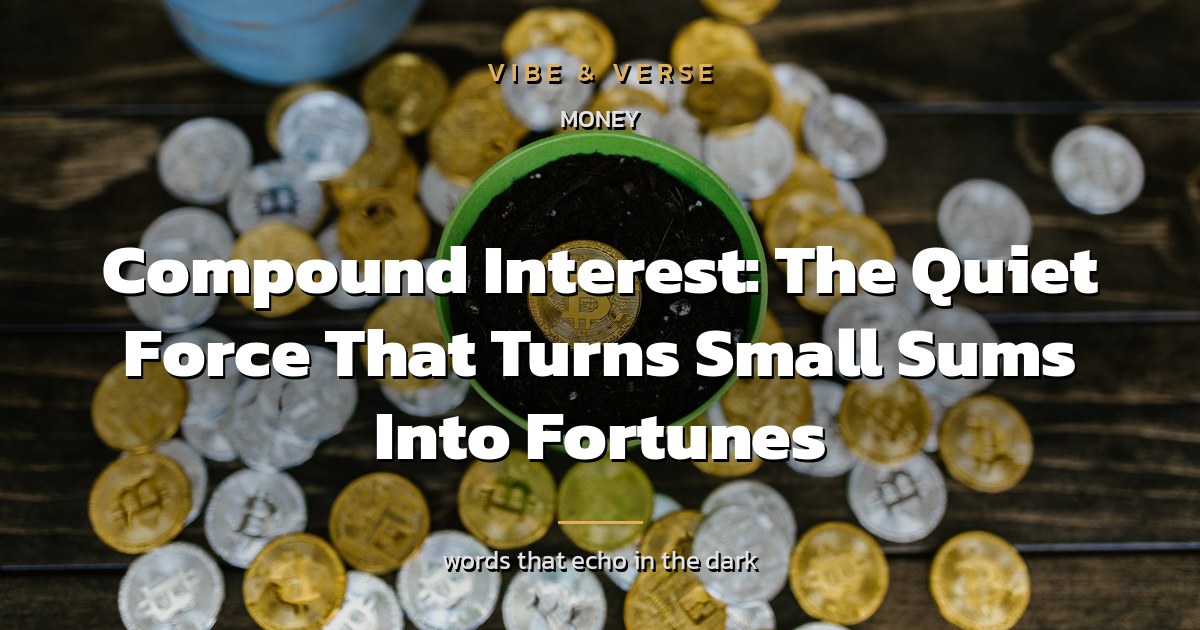
Imagine two friends. One starts saving a modest amount in their twenties and stops after ten years. The other waits until their thirties and then saves diligently for thirty years straight. Astonishingly, the early starter can end up with more money — despite saving for a third as long. The secret behind this strange arithmetic is compound interest, often called the most powerful force in personal finance.
What Compound Interest Actually Is
Simple interest earns money only on the amount you originally put in. Compound interest earns money on your original amount and on all the interest it has already earned. In other words, your money makes money, and then that new money starts making money too. Each cycle builds on the last, so growth accelerates over time.
It's the difference between growth that adds and growth that multiplies. Early on, the effect is barely noticeable. But given enough time, it becomes dramatic.
The Snowball Effect
The best way to picture compound interest is a snowball rolling downhill. At first it's small and gathers snow slowly. But as it grows, its larger surface picks up more snow with each turn, and it swells faster and faster. Your savings work the same way: the bigger the balance grows, the more each cycle adds, creating a self-reinforcing loop that speeds up the longer it runs.
This is why the later years of a long-term investment often add far more than the early ones. The growth isn't a straight line — it curves upward.

Why Time Is the Secret Ingredient
Because compounding accelerates over time, the single most important factor isn't how much you invest — it's how long you let it grow. Every extra year gives your money another cycle to multiply. This is why starting early is so powerful: a small sum invested in your twenties can outgrow a much larger sum invested in your forties, simply because it had more time to compound.
The flip side is a hard truth: delay is expensive. Every year you wait isn't just a year of missed saving — it's a year of missed multiplication that you can never fully get back.
The Dark Side: Debt
Compound interest is a loyal servant but a brutal master. The same force that grows your savings can grow your debts. Credit cards and high-interest loans compound against you, so unpaid balances can snowball just as relentlessly. Understanding this is half the battle: you want compounding working for you through investments, not against you through debt.
Putting It to Work
You don't need to be wealthy or an expert to harness it:
- **Start now, even small.** Time matters more than amount. A little invested today can beat a lot invested years from now.
- **Be consistent.** Regular contributions feed the snowball and keep it growing steadily.
- **Leave it alone.** Compounding rewards patience. The longer you let it run without interrupting, the more powerful it becomes.
- **Kill high-interest debt first.** Escaping debt that compounds against you is one of the surest financial wins there is.
The Takeaway
Compound interest is the quiet engine behind nearly all lasting wealth, and its lesson is beautifully simple: small amounts, plus patience, plus time, can grow into something remarkable. It rewards those who start early and stay consistent, and it punishes delay silently. You don't need luck or genius to benefit — you just need to begin, keep going, and give this gentle, relentless force the one thing it needs most: time.



Be the first to share a thought.