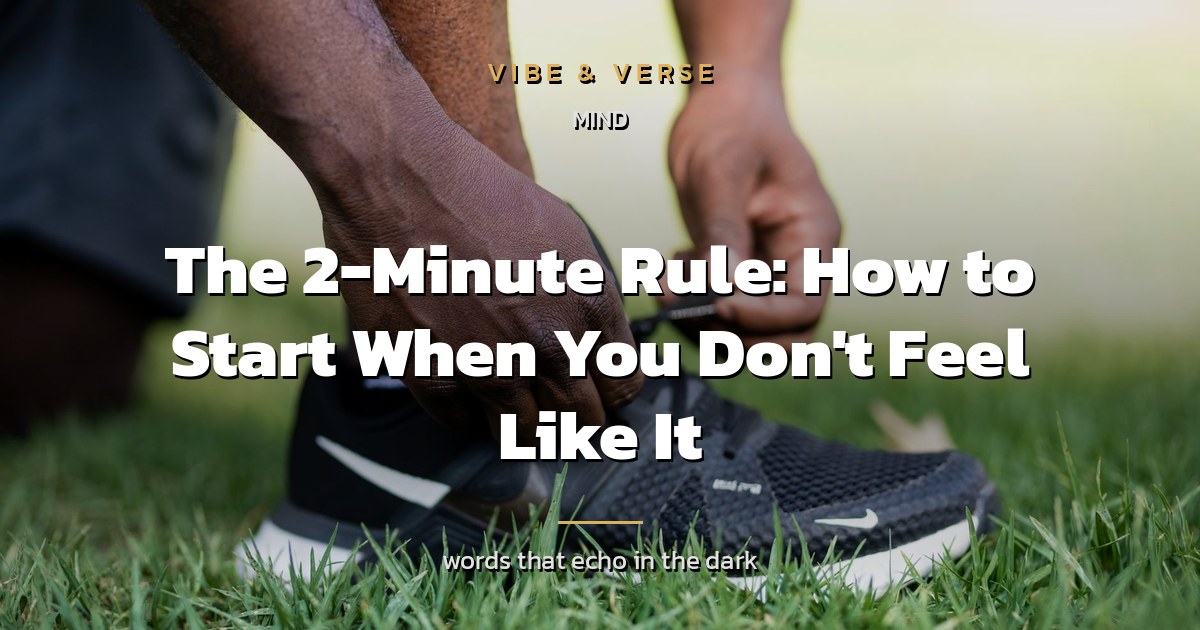
You already know the feeling. There's something you should be doing — the workout, the report, the email you've been avoiding for three days — and instead you're staring at your phone, promising yourself you'll start in five minutes. Then five becomes fifty.
Here's the uncomfortable truth: motivation is not the thing that gets you started. Action is. And the easiest way to trick yourself into action is a rule so small it feels silly.
What the 2-Minute Rule Actually Says
Popularized by author James Clear, the 2-Minute Rule has one instruction: when you start a new habit, it should take less than two minutes to do.
- "Read before bed" becomes "read one page."
- "Do yoga" becomes "put down my mat."
- "Write the report" becomes "open the document and write one sentence."
It sounds too easy to matter. That's exactly why it works.
Why Your Brain Fights the Start
Your brain is wired to avoid effort it perceives as large. When a task feels heavy, it triggers a small stress response, and you reach for something comforting instead — usually your phone. This isn't laziness. It's a protection instinct that misfires in a world of long to-do lists.
The 2-Minute Rule sidesteps the instinct completely. Two minutes is too small to feel threatening, so your brain lets you begin. And beginning is the whole game.

The Real Secret: Motion Creates Motivation
Once you've started, something quietly shifts. A body in motion wants to stay in motion. You told yourself you'd write one sentence, and now you've written a paragraph. You put on your running shoes to stand by the door, and now you're outside.
Motivation, it turns out, usually arrives after you start — not before. We wait to feel ready, but readiness is a reward for beginning, not a requirement for it.
How to Use It This Week
Pick one thing you keep avoiding. Shrink it until the first step takes two minutes or less. Then do only that step — and give yourself full permission to stop afterward.
- Want to journal? Write one line.
- Want to clean the kitchen? Wash one plate.
- Want to study? Open the book to the right page.
Most days, you won't stop. But on the days you do, you still win — because you kept the habit alive, and a habit you keep small is a habit you keep for life.
The Bigger Idea
We overestimate what we can do in a burst of motivation and underestimate what two quiet minutes, repeated daily, can build. A habit that sticks isn't forged in one heroic effort. It's forged in the boring, repeatable start you can do even on your worst day.
Start smaller than feels reasonable. Then let motion do the rest.


Be the first to share a thought.