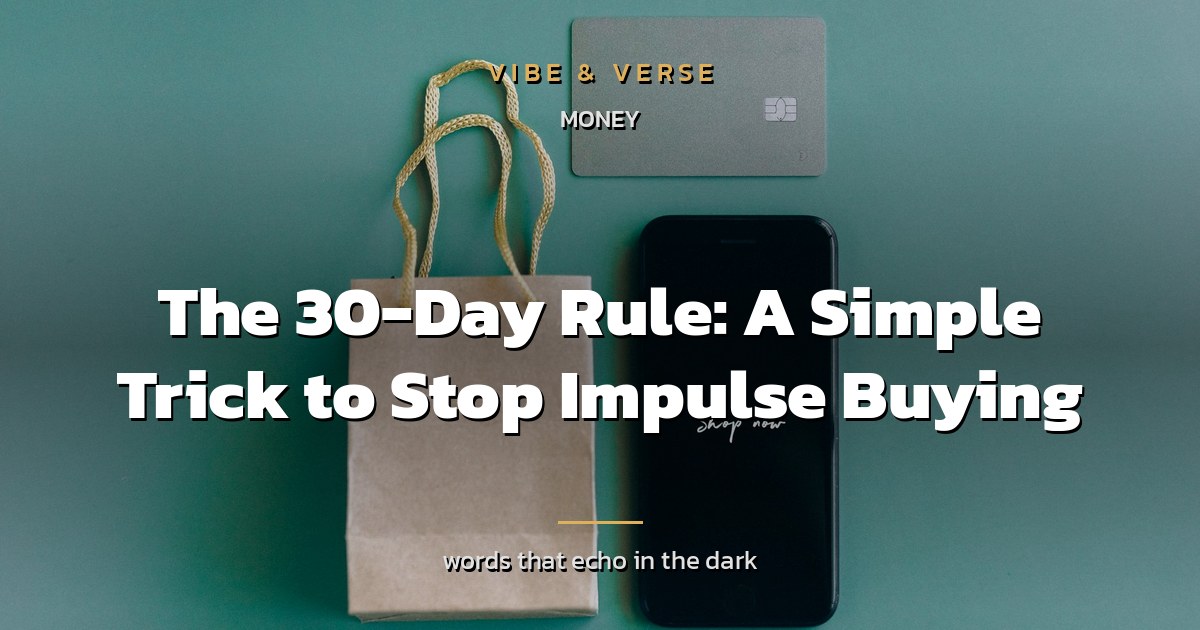
Nearly everyone has a drawer, cupboard, or corner of a hard drive full of things that seemed essential at the time. Impulse purchases rarely feel impulsive in the moment — they feel justified, urgent, even sensible. The problem is that the feeling is temporary while the payment is permanent. The 30-day rule is one of the simplest tools for telling the difference, and it costs nothing to try.
What the Rule Is
The rule is exactly what it sounds like. When you want to buy something that isn't a necessity and costs more than a threshold you set — many people use fifty or a hundred dollars — you write it down with the date and wait thirty days. If you still want it after thirty days and can still afford it, you buy it, with no guilt at all. If you've forgotten about it or the desire has faded, you've saved the money without ever having to feel deprived.
Why It Works
**Desire has a short half-life.** The peak intensity of wanting something usually occurs within minutes of first seeing it. Retailers know this, which is why countdown timers, low-stock warnings, and one-click purchasing exist. Time is the natural enemy of manufactured urgency.
**It removes the feeling of restriction.** Traditional budgeting says no, and being told no triggers resistance. The 30-day rule says "yes, later." Psychologically that's far easier to accept, so people stick with it longer.
**It converts emotion into information.** Writing the item on a list turns a feeling into a data point. When you review your list a month later, you can see plainly which desires were real and which were mood.
**It reveals the pattern.** After a few months, the list itself becomes a mirror. Many people discover their impulse purchases cluster around specific triggers — Sunday evenings, after a hard day at work, late at night, after scrolling social media. Once you see the trigger, you can address the actual need rather than buying around it.
How to Set It Up
**Pick a threshold that matches your income.** The rule should apply often enough to matter but not so often that it becomes exhausting. If you find yourself skipping it, the threshold is too low.
**Keep one list, somewhere easy.** A note on your phone works fine. Record the item, the price, the date, and one line about why you want it. That last part is surprisingly revealing when you read it back.

**Exempt genuine necessities.** Groceries, medicine, replacing a broken appliance you actually use — these don't belong on the list. The rule targets wants, not needs, and mixing them in makes it collapse.
**Use a shorter version for small amounts.** A 24-hour or 72-hour rule works well for cheaper items where thirty days would be overkill.
**Remove saved payment details.** Having to fetch your card creates a small friction that gives the rule time to activate. Convenience is the enemy here.
What to Expect
Most people find that somewhere between half and three-quarters of the items on their list lose their appeal within a month. The remaining purchases tend to be more satisfying, partly because they've survived a test and partly because you buy them deliberately rather than reactively.
You'll also occasionally find the opposite: an item you keep thinking about for weeks. That's valuable information too. It means the want is real, and you can buy it without second-guessing yourself.
Where the Rule Struggles
It works less well against subscription services, which sneak past the threshold by being individually cheap. For those, an annual audit of recurring charges is the better tool.
It also doesn't help if the underlying issue is emotional spending as a coping mechanism. The rule creates space to notice that pattern, but noticing is only the first step. If shopping is how you manage stress, loneliness, or boredom, the money problem is downstream of something that deserves attention in its own right.
The Bottom Line
The 30-day rule isn't about denying yourself anything. It's about making sure the person who pays is the same person who decided — not a version of you who was tired, bored, or caught by a well-designed countdown timer. Try it for three months, keep the list, and read it back. The list alone will teach you more about your spending than any budgeting app.


Be the first to share a thought.