The research began with a murder and a newspaper story that was substantially wrong.
In 1964, Kitty Genovese was killed outside her apartment building in Queens, New York. Two weeks later The New York Times reported that 38 respectable, law-abiding citizens had watched the attack from their windows and not one had called the police.
That account has since been thoroughly dismantled. Later investigation found the number was inflated, most people heard rather than saw anything, the layout of the buildings made it nearly impossible to observe the full attack, at least one person shouted at the attacker, and at least one call was made to police. A neighbour went to her and held her as she died.
But the story, accurate or not, sent two psychologists — John Darley and Bibb Latané — looking for whether crowds really do suppress helping. And that part turned out to be true.
The experiments
In their best-known study, participants sat alone in a room and took part in a discussion over an intercom, believing other students were in separate rooms. During the discussion, one voice appeared to have a seizure, choking and asking for help.
The variable was how many other participants the subject believed were listening.
- When the subject thought they were the only other person, 85 percent went for help, most within a minute.
- When they believed there were four others, only 31 percent did.
In a separate study, participants filled out a questionnaire while smoke began seeping into the room through a vent. Alone, 75 percent reported it. In a group that included confederates instructed to remain calm and keep working, only 10 percent did. Some participants sat in a room filling with smoke for six minutes rather than be the one to say something.
The finding has been replicated many times across decades, and a large meta-analysis confirmed the basic pattern while adding an important qualification: in situations that are clearly dangerous, and where the bystanders are physically present rather than merely assumed, the effect shrinks and sometimes reverses. Real-world CCTV studies of public conflicts find that someone intervenes in the large majority of cases, and that more bystanders can increase the chance that at least one person acts.
So the effect is real, but the popular version — that crowds are callous and nobody ever helps — overstates it.
The three mechanisms
Diffusion of responsibility
When many people could act, the felt obligation to act divides among them. Alone, responsibility is 100 percent yours. With ten others present, it feels like a tenth. Nobody consciously calculates this, but the sense of personal duty measurably weakens.
Pluralistic ignorance
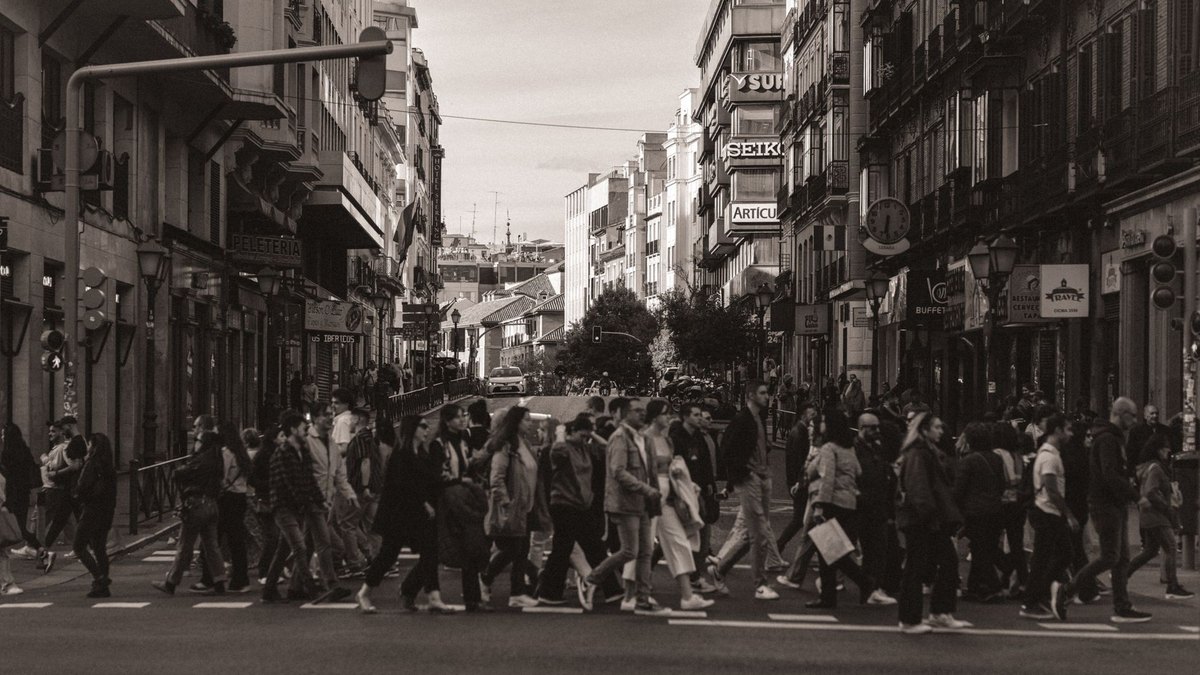
Ambiguous situations get read by looking at other people. But everyone else is also looking around, also trying to appear composed, and also reading calm faces. The group collectively concludes nothing is wrong — from evidence that consists entirely of each other's uncertainty. This is why the smoke study produced such an extreme result: the situation was unclear, and calm confederates supplied a confident-looking answer.
Evaluation apprehension
Fear of being wrong in public. Of overreacting, of misreading a couple's argument, of looking foolish, of being the one who called an ambulance for a man who was merely drunk. The larger the audience, the more this weighs.
Which factors change the outcome
- Clarity. Unambiguous emergencies produce far more helping than ambiguous ones. Most of the effect lives in the gap where people are unsure whether something is actually wrong.
- Competence. People who believe they know what to do — those with first aid or medical training — help far more consistently. Knowing the steps removes the fear of doing it badly.
- Relationship. Groups of friends help more readily than groups of strangers, because pluralistic ignorance is easier to break when you can simply ask someone what they think.
- Time pressure. In one famous study, seminary students on their way to give a talk — some of them on the parable of the Good Samaritan — walked past a slumped, groaning man. Whether they stopped depended overwhelmingly on whether they had been told they were running late. Situation beat both personality and subject matter.
- Cost. Physical risk reduces intervention, though less than most people predict.
What actually breaks the effect
If you need help: destroy the ambiguity and destroy the diffusion.
Point at one specific person and address them directly. "You, in the blue jacket — call an ambulance." Naming a person converts diffuse responsibility into an individual assignment in front of witnesses, and it is remarkably effective. Then assign a second task to a second person: "You, in the grey shirt, find a defibrillator."
Also state plainly what is happening. "I am having a heart attack" leaves no room for the crowd to conclude you are drunk or unwell in some undramatic way.
If you are a bystander: assume you are the one.
Act as if nobody else will, because the entire mechanism relies on everyone assuming somebody else has it covered. Being the first to move is the hard part; once one person acts, others usually join quickly, since the ambiguity has been resolved for them.
Say something out loud. "Is he okay?" spoken to the person next to you breaks pluralistic ignorance for everyone in earshot. It costs nothing and it turns a group of separately uncertain individuals into people who can coordinate.
And accept the possibility of being wrong. The genuine cost of checking on someone who turns out to be fine is a moment of mild awkwardness. The cost of everyone deferring is on a different scale entirely.
The wider version
The same dynamic operates well beyond emergencies. It appears in the group project where every member assumes another will start, in the meeting where everyone privately notices a flaw in the plan and nobody names it, in the organisation where a known problem persists for years because it is nobody's specific job.
Every effective countermeasure is the same one: convert "someone should" into "this named person will, by this date."
The short version
More witnesses can mean less help, driven by diffused responsibility, everyone reading everyone else's calm as evidence, and fear of looking foolish. The effect is weaker in clearly dangerous situations and among trained or acquainted people.
To get help, point at one person and give them a specific instruction. To give help, assume nobody else is coming — and say something out loud, because the first voice is what frees everyone else to act.



Be the first to share a thought.