Point a sensitive radio antenna at any patch of empty sky — no stars, no galaxies, just darkness — and you'll still detect a faint hum of energy coming from every direction at once. This whisper isn't from any star or galaxy. It's the afterglow of the Big Bang itself, the oldest light in the universe. Astronomers call it the Cosmic Microwave Background, and it may be the single most important discovery in modern cosmology.
Light From the Dawn of Time
To understand what the CMB is, rewind the universe to its infancy. In the beginning, the cosmos was unimaginably hot and dense — so hot that atoms couldn't form. The universe was a glowing fog of charged particles, and light couldn't travel freely; it bounced around endlessly, trapped in the haze.
Then, about 380,000 years after the Big Bang, the universe cooled just enough for particles to combine into the first stable atoms. Suddenly the fog cleared, and light was free to stream across space for the first time. That ancient light has been traveling ever since — for over 13 billion years — and it's still arriving today. It is the CMB: a snapshot of the moment the universe became transparent.
Stretched Into Microwaves
When that light was first released, it was a fierce glow. But over billions of years, the universe expanded enormously, and that expansion stretched the light along with it — shifting it from visible radiance all the way down to faint microwave energy, cold and dim. Today it corresponds to a temperature of only about 2.7 degrees above absolute zero, filling all of space with a nearly uniform chill.
That uniformity is astonishing: the CMB looks almost exactly the same in every direction, evidence that the early universe was remarkably smooth and evenly mixed.
Discovered by Accident
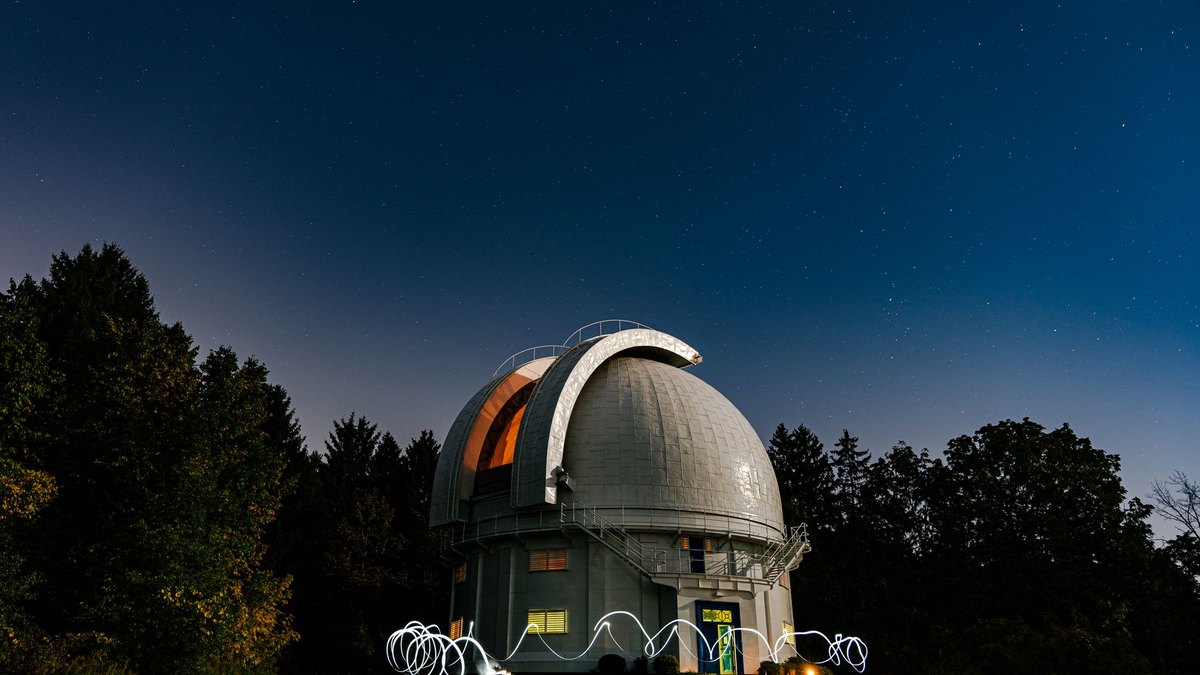
One of the best parts of the story is how it was found. In the 1960s, two researchers working with a large antenna kept picking up a persistent background hiss they couldn't eliminate. They checked their equipment, ruled out interference, and even cleaned out pigeon droppings from the antenna, convinced the noise was a flaw. It wasn't. They had accidentally stumbled onto the faint radiation predicted by Big Bang theory — a discovery that would earn a Nobel Prize and reshape our understanding of the cosmos.
The Universe's Baby Picture
The CMB is far more than a curiosity. It's a treasure map. Embedded in it are tiny variations — regions very slightly warmer or cooler than average. These minuscule ripples are the seeds from which everything grew: the denser patches eventually collapsed under gravity to form galaxies, stars, and ultimately us. By studying the exact pattern of these fluctuations, scientists have measured the age of the universe, its composition, and its overall shape with remarkable precision.
In a real sense, the CMB is the oldest photograph in existence — a portrait of the infant universe, taken before a single star had ever formed.
The Takeaway
The next time you hear about the "empty" darkness between the stars, remember it isn't empty at all. It's suffused with an ancient glow that has been traveling since the universe was newborn. The Cosmic Microwave Background connects us directly to the beginning of everything — a faint, cold light that carries the story of the cosmos, and quietly confirms that our universe truly had a beginning.

Be the first to share a thought.