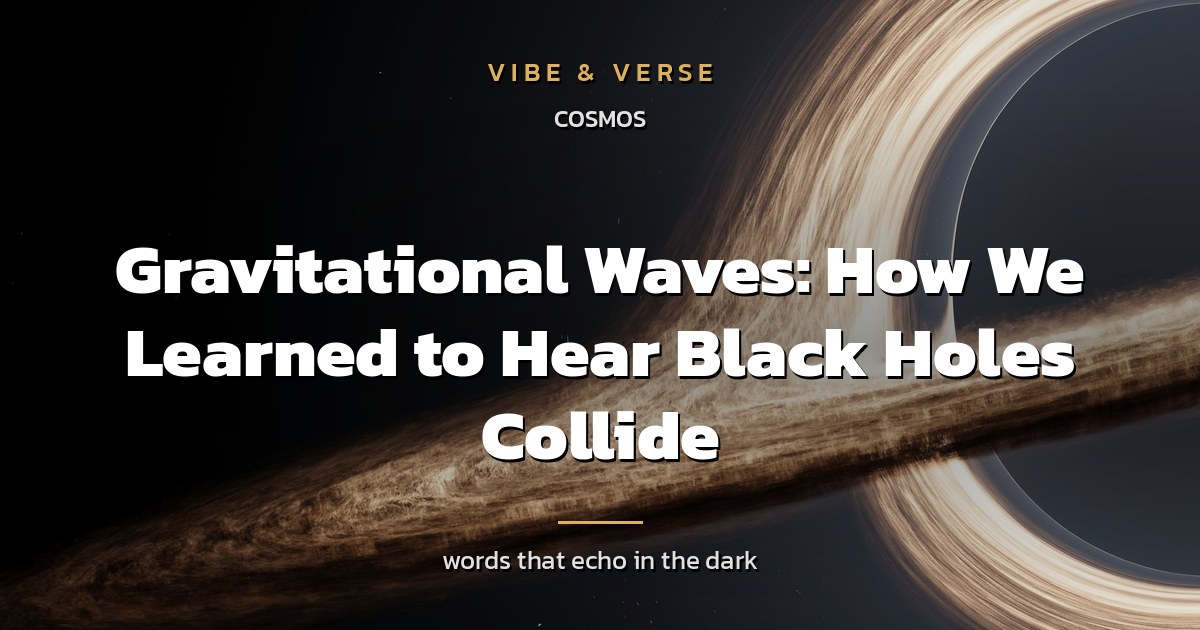
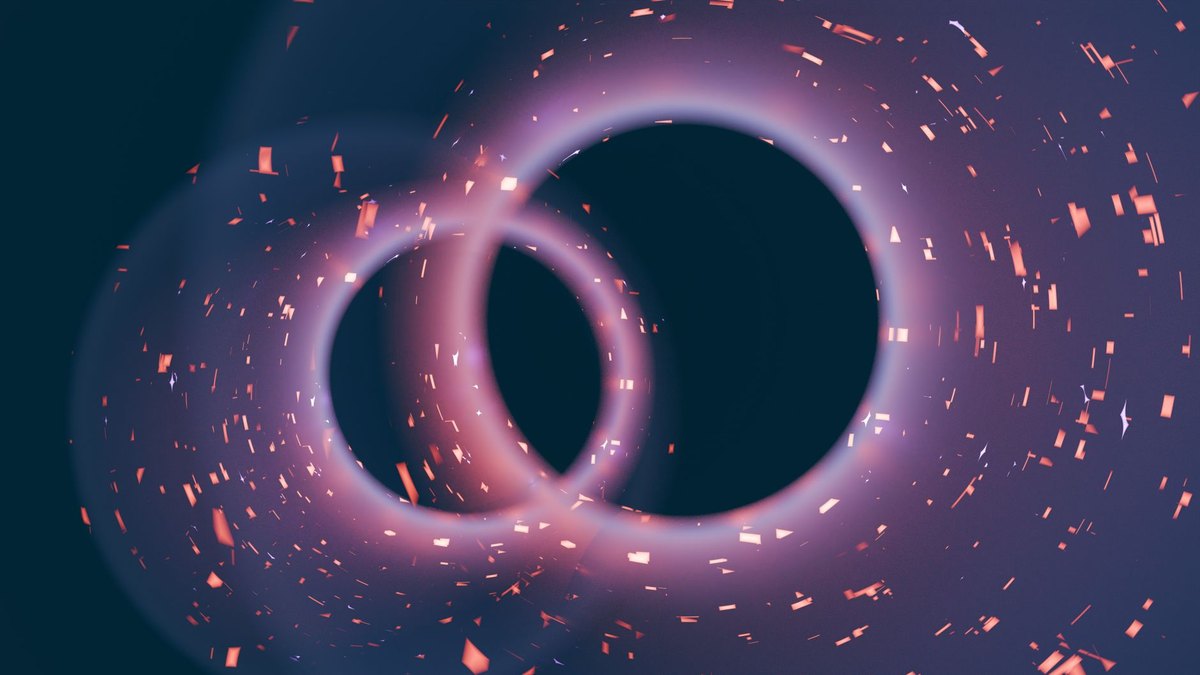
On 14 September 2015, two enormous instruments in Louisiana and Washington State registered a tiny, rising whoop of a signal, seven milliseconds apart. It lasted about 0.2 seconds. What produced it was two black holes, each around 30 times the mass of the Sun, spiralling into each other and merging into one — an event that happened 1.3 billion years ago, when the most complex life on Earth was single-celled.
That detection confirmed a prediction Einstein published in 1916, and gave astronomy an entirely new sense. For all of human history we had studied the universe by looking at it. Now we could feel it.
What a gravitational wave actually is
In Einstein's general relativity, gravity is not a force pulling objects together. It is the shape of spacetime itself. Mass and energy curve spacetime, and objects move along the curves. The usual analogy is a bowling ball on a stretched rubber sheet, which is imperfect but conveys the idea.
Now shake the bowling ball. Ripples spread outward across the sheet.
Gravitational waves are those ripples. When massive objects accelerate in an asymmetric way, they radiate distortions of spacetime that travel outward at the speed of light. As a wave passes through a region, it stretches space in one direction and squeezes it in the perpendicular direction, then reverses, over and over.
This means it stretches and squeezes you. Right now, gravitational waves from distant collisions are passing through your body, changing your height and width by an amount far too small to notice — and far too small, for a long time, to imagine measuring.
Why they are so hard to detect
Gravity is astonishingly weak. You can demonstrate this at home: pick up a paperclip with a small magnet, and a few grams of magnetised metal will overcome the gravitational pull of the entire planet.
Because gravity is weak, spacetime is extremely stiff. It takes a colossal event to make it ripple detectably, and even then the ripple arrives tiny. The 2015 signal changed the length of a 4-kilometre detector arm by about one ten-thousandth the width of a proton. That is roughly like measuring the distance to the nearest star and detecting a change the width of a human hair.
Einstein himself doubted these waves would ever be observed. At one point in the 1930s he even submitted a paper arguing they did not physically exist — a paper he withdrew after a referee found an error in the reasoning.
How LIGO works
The Laser Interferometer Gravitational-Wave Observatory uses an idea more than a century old, executed with extraordinary precision.
- A laser beam is split in two and sent down two perpendicular arms, each 4 km long.
- Mirrors at the ends reflect the beams back, and the two beams recombine.
- The arms are tuned so that, normally, the recombined light waves cancel each other out, and the detector sees darkness.
- If a gravitational wave passes through, it stretches one arm and squeezes the other. The beams no longer cancel perfectly, and a flicker of light appears.
Everything else is the fight against noise. The arms are held in an ultra-high vacuum. The mirrors hang from multi-stage pendulums to isolate them from ground vibration. The lasers are stabilised to extremes. And crucially, there are two widely separated detectors: a passing gravitational wave should hit both, with a delay of no more than the light-travel time between them. A truck rumbling past one site will not.
The 2015 event, catalogued as GW150914, appeared in both detectors with a 7-millisecond offset and the exact waveform shape that general relativity predicts for two merging black holes. It was not a marginal result.
What we have learned since
The detectors, now joined by Virgo in Italy and KAGRA in Japan, have recorded well over a hundred merger events. The scientific payoff has been broad:
Black holes are real, and they collide. Before 2015, black holes were inferred indirectly from their effects on nearby matter. Gravitational waves gave direct evidence of the objects themselves.
There were black holes we did not expect. Several detected black holes are heavier than stellar-evolution models comfortably predicted, forcing revisions to how massive stars die.
We saw a kilonova. In August 2017, detectors caught the merger of two neutron stars, and telescopes worldwide swung to the location and observed the resulting explosion across the electromagnetic spectrum. That event showed that neutron-star mergers forge heavy elements — a significant fraction of the gold and platinum in the universe, and in your jewellery, was probably made in collisions like it.
Gravity travels at the speed of light. In the 2017 event, the gravitational waves and the gamma rays arrived within about 1.7 seconds of each other, after travelling 130 million years. That agreement ruled out whole families of alternative gravity theories overnight.
What "hearing" means here
Astronomers often describe gravitational-wave astronomy as listening rather than looking, and the metaphor is more than poetic. The frequencies of these signals fall within the range of human hearing — the 2015 merger, shifted into audio, is a rising "chirp" lasting a fraction of a second.
More importantly, the information is genuinely different in kind. Light is easily blocked: by dust, by gas, by the opaque plasma of the early universe. Gravitational waves pass through essentially everything. They carry information out of regions no telescope can see into, including the moment two black holes touch.
This is why the field matters. For four centuries, better astronomy meant better light collection — bigger mirrors, new wavelengths, telescopes above the atmosphere. Gravitational waves are not a better version of that. They are a separate channel, carrying information light cannot.
What comes next
Detectors are being upgraded to reach further. LISA, a planned space-based observatory with arms millions of kilometres long, will detect much lower frequencies — the slow orbits of supermassive black holes at galactic centres. Pulsar timing arrays, which use the precise clock-like pulses of distant neutron stars as a natural detector spanning the galaxy, have already reported evidence of a low-frequency gravitational-wave background.
The distant hope is to detect gravitational waves from the first fraction of a second after the Big Bang. Light cannot reach us from that era; the early universe was opaque. Gravitational waves would not have been stopped.
The short version
Gravitational waves are ripples in the fabric of spacetime, produced when massive objects accelerate violently. They are unimaginably small by the time they arrive, which is why detecting them required measuring a distance change thousands of times smaller than a proton. We now do this routinely, and each detection tells us about objects that emit no light at all.
A century separated the prediction from the confirmation. Einstein thought it might never be done.

Be the first to share a thought.