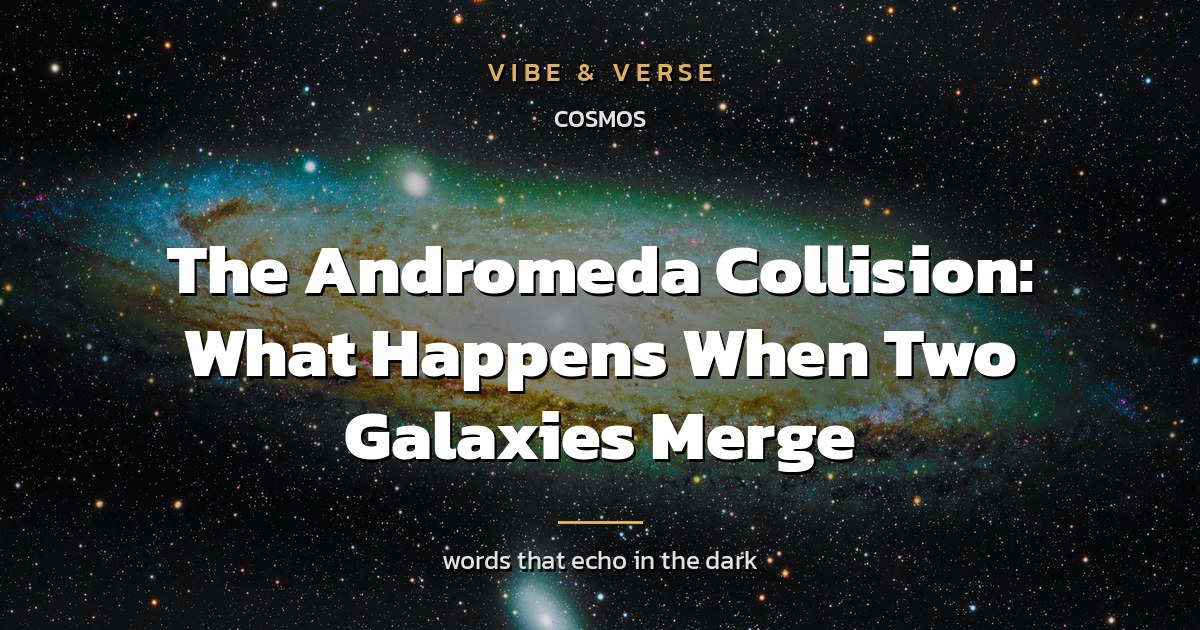
Nearly everything in the universe is moving away from us. The expansion of space carries distant galaxies outward, and their light arrives stretched toward the red end of the spectrum.
The Andromeda galaxy is one of the exceptions. Its light is blueshifted, which means it is moving toward us — at roughly 110 kilometres per second.
Andromeda is currently about 2.5 million light-years away. At that closing speed, the two galaxies will begin to interact in around four billion years.
Why gravity beats expansion here
The expansion of the universe operates on the largest scales. Within a gravitationally bound system, local gravity wins easily.
The Milky Way and Andromeda are the two dominant members of the Local Group, a collection of more than eighty galaxies bound together gravitationally. Inside that group, expansion is irrelevant. The two large spirals have been falling toward each other since long before the Sun formed.
Determining the exact outcome required more than knowing the approach speed. A head-on collision and a near miss look identical if you only measure motion along the line of sight. Astronomers needed the sideways motion — the transverse velocity — and that is extraordinarily difficult to measure for an object 2.5 million light-years away.
Measurements using the Hubble Space Telescope, tracking Andromeda's position against distant background galaxies over several years, found the transverse motion to be small. That pointed to a direct encounter rather than a glancing pass.
More recent work, incorporating data from the Gaia mission and improved estimates of the mass of the Local Group, has softened that conclusion somewhat. Some analyses now put the probability of a full merger within the next ten billion years closer to a coin flip, with the possibility of a distant first passage instead. The uncertainty comes from how much dark matter each galaxy carries and how the Large Magellanic Cloud perturbs the Milky Way's motion.
The honest current position: a merger is likely eventually, and the timing and geometry are less settled than the confident diagrams of a decade ago suggested.
Stars will not hit each other
This is the part that surprises people most.
Galaxies are overwhelmingly empty. The Sun's nearest neighbour, Proxima Centauri, is about 4.2 light-years away — roughly 30 million times the Sun's own diameter. Scaled down, if the Sun were a grain of sand, the next grain would be several kilometres away.
When two galaxies pass through each other, the probability of any two stars physically colliding is effectively zero. Simulations of galaxy mergers consistently find no stellar collisions at all.
What does collide is gas. Interstellar gas clouds are enormous and diffuse, and unlike stars they cannot pass through one another. They compress, shock, and collapse — which triggers a burst of new star formation. Merging galaxies observed elsewhere in the universe frequently show exactly this signature: brilliant regions of newborn stars along the compression fronts.
The two supermassive black holes at the galactic centres will also eventually meet. They will spiral inward over hundreds of millions of years, shedding energy as gravitational waves, before merging into a single larger black hole.
What actually changes
Gravity rearranges structure, and that is the dramatic part.
Tidal forces during the first passage will draw out long streamers of stars — tidal tails — stretching hundreds of thousands of light-years into intergalactic space. Many will never return. Some stars, including possibly the Sun, will be flung into wider orbits or ejected entirely.
The galaxies will separate after the first pass, then fall back together, then pass again. Each encounter bleeds orbital energy. After several passages over roughly a billion years, the two spirals will settle into a single object.
That object will not be a spiral. Spiral arms require ordered rotation in a flat disc, and the merger destroys that ordering. The result will be an elliptical galaxy — a smooth, roughly spheroidal swarm of stars on randomised orbits, with little remaining gas and therefore little ongoing star formation. Astronomers have already named the hypothetical result Milkomeda.
What it would look like from Earth
Assuming anyone were here to watch, the sky would change slowly and then spectacularly.
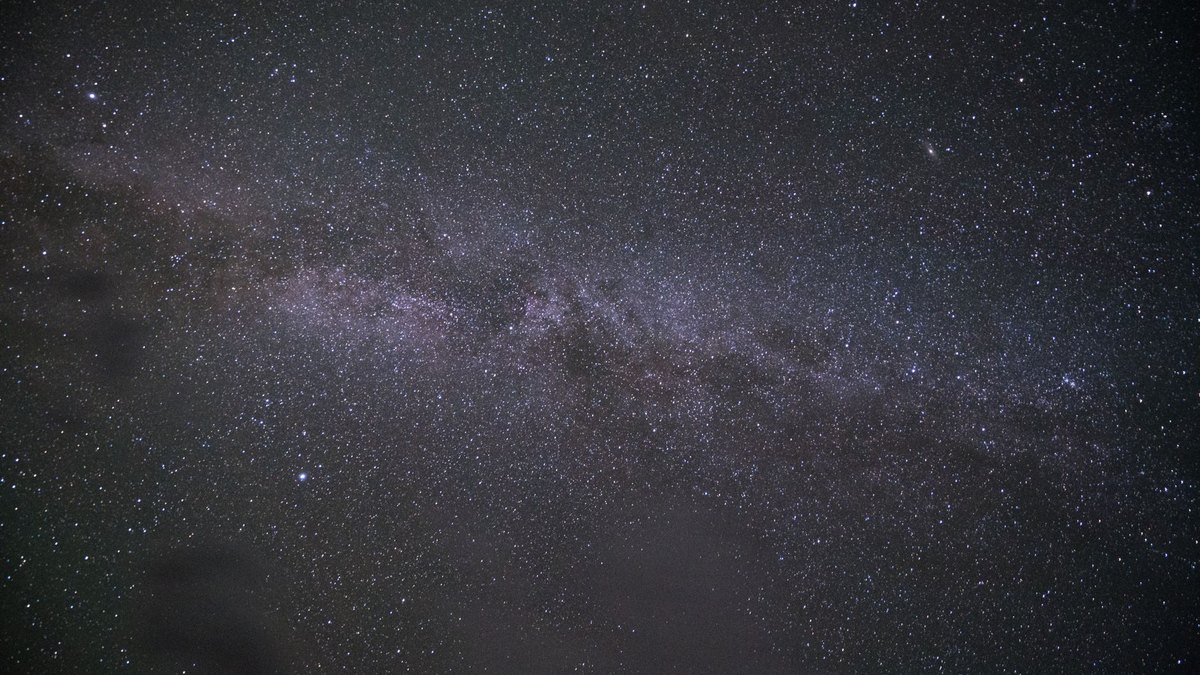
Andromeda is already visible to the naked eye from dark sites as a faint smudge. Over the next few billion years it would grow, first filling a noticeable patch of sky, then dominating it — a vast luminous disc spanning a large fraction of the visible hemisphere.
During the merger, the sky would show two overlapping galactic structures, distorted, with bright pink knots of star-forming regions along the shock fronts. Nights would be considerably brighter.
The whole sequence would unfold over hundreds of millions of years. No observer would perceive motion. Each generation would see a slightly different arrangement of a permanent-seeming sky.
The Sun will be gone first
There is a complication that makes the human relevance of all this essentially nil.
The Sun is around 4.6 billion years old. In roughly one billion years, its steadily increasing luminosity is expected to raise Earth's temperature enough to boil the oceans, ending surface life well before the merger begins. In about five billion years the Sun will exhaust its core hydrogen and expand into a red giant, likely engulfing or scorching Earth, before shedding its outer layers and leaving a white dwarf.
So the collision is not a threat to Earth in any meaningful sense. Earth's habitability will end for entirely local reasons long beforehand.
Why astronomers care
Mergers are how large galaxies are built. Both the Milky Way and Andromeda are themselves products of earlier mergers, and the Milky Way's halo contains identifiable streams of stars from galaxies it has already absorbed.
This is the standard picture of galaxy formation: small structures form first and assemble into larger ones over cosmic time. Elliptical galaxies, common in dense clusters, are understood largely as merger products.
Watching mergers elsewhere in the universe — and modelling our own future one — is how that picture gets tested.
Summary
Andromeda is approaching, and the Milky Way will probably merge with it several billion years from now, though the timing and geometry are less certain than they were once presented.
When it happens, no stars will hit each other. Gas clouds will collide and ignite bursts of new stars, gravity will tear out enormous tidal tails, the two central black holes will spiral together, and both spiral structures will be destroyed — leaving a single elliptical galaxy where two spirals used to be.
The Earth will not be around to see it. But the event is a useful reminder that the sky is not a fixed backdrop. It is a slow-motion process, and we happen to be looking at one frame of it.

Be the first to share a thought.