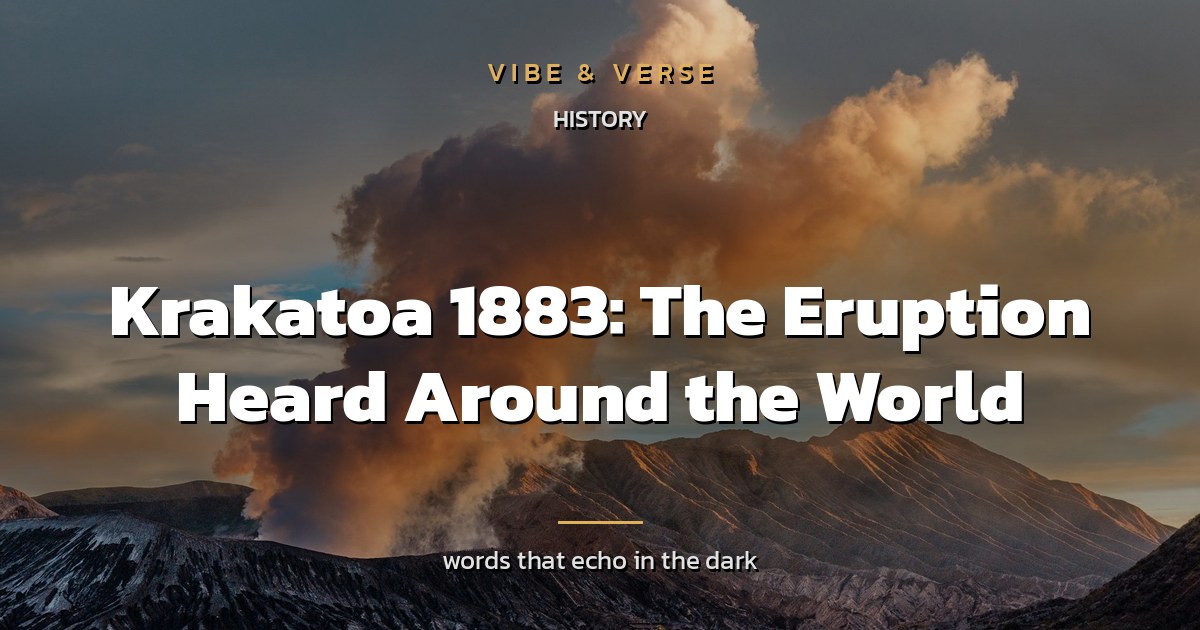
On the morning of 27 August 1883, a volcanic island in the Sunda Strait between Java and Sumatra destroyed itself. The final explosion is estimated to have been heard 4,800 kilometres away, on Rodrigues Island near Mauritius, where a police chief recorded what he took to be distant naval gunfire. It remains the loudest sound in recorded history.
Krakatoa killed more than 36,000 people, almost all of them by water rather than fire. It cooled global temperatures for years. And because a telegraph cable ran through the region, it became the first natural disaster the whole world learned about within hours.
The setup
Krakatoa sat in the Sunda Strait, a narrow channel of heavy shipping traffic. The island was roughly nine kilometres long with three volcanic cones — Perboewatan, Danan and Rakata. It was the remnant of a much larger volcano that had collapsed in a prehistoric eruption, leaving a caldera partly filled by later growth.
This is a subduction zone: the Indo-Australian plate grinding beneath the Eurasian plate. Water carried down with the descending plate lowers the melting point of the rock above it, generating magma that is thick, sticky and rich in dissolved gas. Thick magma traps gas rather than letting it escape, which is why volcanoes in this setting explode instead of pouring out lava.
Krakatoa had been quiet since 1681. In May 1883 it woke up.
Three months of warning
On 20 May, the crew of a German warship reported an ash cloud rising some eleven kilometres above Perboewatan. Explosions were heard in Batavia, today's Jakarta, over 160 kilometres away, loud enough to rattle windows.
Activity continued through June and July. By August, ships passing through the strait reported pumice rafts thick enough to slow them down, and a column of ash and steam standing permanently over the island. On 11 August a surveyor landed and found three vents erupting.
Remarkably, this was treated more as spectacle than threat. Excursion boats took sightseers out to watch. The scale of what a caldera collapse could do was simply not understood at the time.
26 and 27 August
Around midday on Sunday 26 August, the eruption entered its final phase. Explosions came every ten minutes. The ash column reached roughly 25 kilometres. Ships in the strait were pelted with hot pumice and reported compasses spinning wildly in the electrically charged ash.
The catastrophic sequence came the next morning. Four enormous explosions were recorded:
- 05:30 — the first, which generated a tsunami that struck Telok Betong
- 06:44 — the second
- 10:02 — the largest, the one heard thousands of kilometres away
- 10:41 — the last, as the northern part of the island collapsed
The 10:02 explosion is estimated at roughly 200 megatons of TNT equivalent — several thousand times the Hiroshima bomb. The pressure wave was recorded on barographs at weather stations around the world, and it circled the planet at least three and a half times before fading.
Within about 20 kilometres of the volcano, the sound level would have exceeded the threshold at which air pressure ruptures eardrums. Sailors on the British ship Norham Castle, 65 kilometres away, had their eardrums burst; the captain wrote in his log that he believed the Day of Judgement had come.
When it was over, two-thirds of the island had vanished. Where a mountain had stood, the sea was 250 metres deep.
The water did the killing
The eruption itself killed relatively few people directly. The tsunamis killed almost everyone.
As the magma chamber emptied and the island collapsed into it, the sea rushed into the void and was thrown back out. Waves reaching an estimated 30 metres or more struck the coasts of Java and Sumatra within minutes.
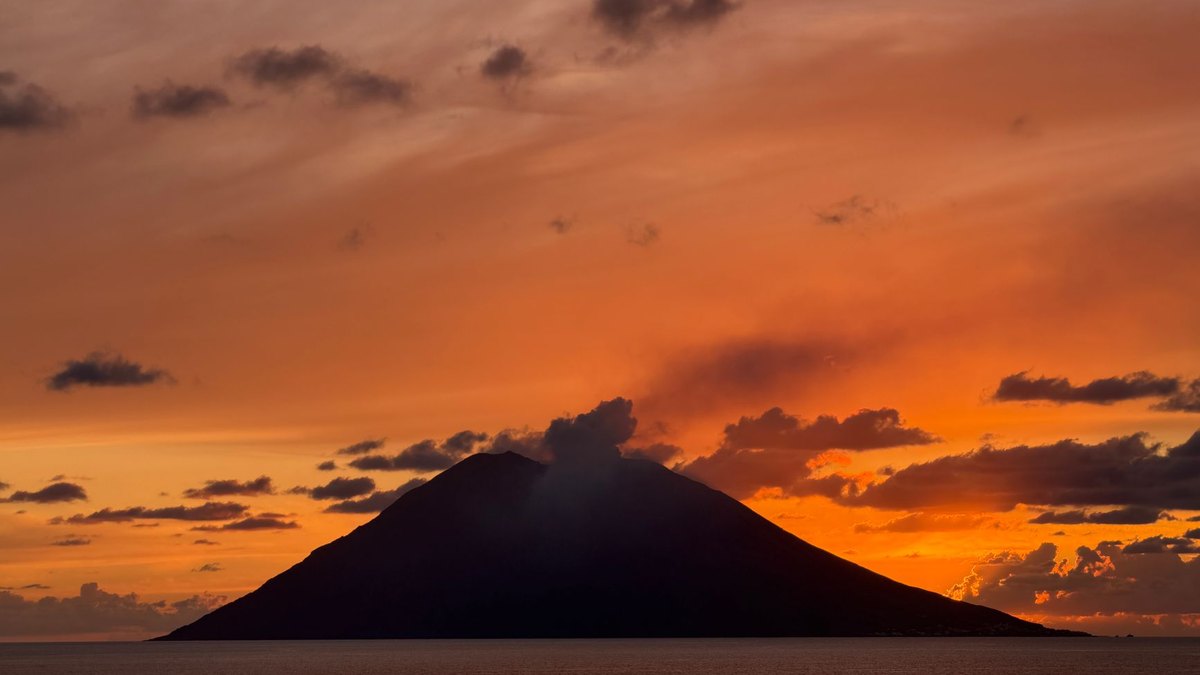
The town of Merak was hit by a wave that reportedly carried inland well above sea level; almost the entire population died. In Telok Betong a Dutch gunboat, the Berouw, was carried nearly three kilometres inland and left in a valley some ten metres above the sea, where its remains stayed for decades as a marker of the wave's reach.
Pyroclastic flows — avalanches of superheated gas and ash — did something that surprised investigators: they travelled across the surface of the sea, insulated by a cushion of steam, and struck the Sumatran coast around 40 kilometres away, killing roughly a thousand people at Ketimbang.
The official Dutch colonial death toll was 36,417. Modern estimates run higher, some above 120,000, since coastal villages that vanished entirely were hard to count.
The world found out immediately
This is the detail that makes Krakatoa a modern event rather than a historical one.
An undersea telegraph cable connected Batavia to Singapore, and from there to the global network. A Lloyd's agent in Batavia wired news of the eruption almost at once. Within hours, editors in London, Boston and Sydney had the story. Newspapers carried reports for months.
For the first time, a disaster on the far side of the world was not a rumour that arrived by ship weeks later. It was news. Historians of media often mark Krakatoa as the moment the world first experienced itself as a single connected place.
The sky changed
Krakatoa injected roughly 20 cubic kilometres of rock and around 20 million tonnes of sulphur dioxide into the atmosphere. The sulphur formed a haze of fine droplets in the stratosphere that reflected sunlight back into space.
Global average temperatures dropped by around 0.4 to 1.2 degrees Celsius in the following year, and weather patterns stayed disturbed for about five years. Rainfall records in several regions show anomalies through the mid-1880s.
The visual effects were extraordinary and worldwide. Sunsets turned deep red and green for months. In Poughkeepsie, New York, and in New Haven, Connecticut, fire brigades were called out to fight what turned out to be the sunset. The Moon appeared blue or green in places — the origin, some argue, of the phrase "once in a blue moon."
Edvard Munch, describing the inspiration for The Scream, wrote of a sky that turned blood red over Oslo, and a number of researchers have connected that memory to Krakatoa's afterglow, though the link remains debated.
What came after
The strait was left ecologically sterile in places, and biologists arrived to watch life recolonise the remnants — one of the first natural experiments in island biogeography. A spider was reportedly the first animal found on the surviving fragment.
In 1927, fishermen noticed steam rising from the water in the caldera. A new cone broke the surface and was named Anak Krakatau — Child of Krakatoa. It grew steadily for decades.
In December 2018, a flank of Anak Krakatau collapsed into the sea, generating a tsunami that killed more than 400 people in Java and Sumatra with no seismic warning at all, because a landslide produces no earthquake for detection systems to catch.
The child, in other words, is still working. And the specific danger it poses — a wave with no warning — is one the modern monitoring network is still not fully equipped to handle.



Be the first to share a thought.