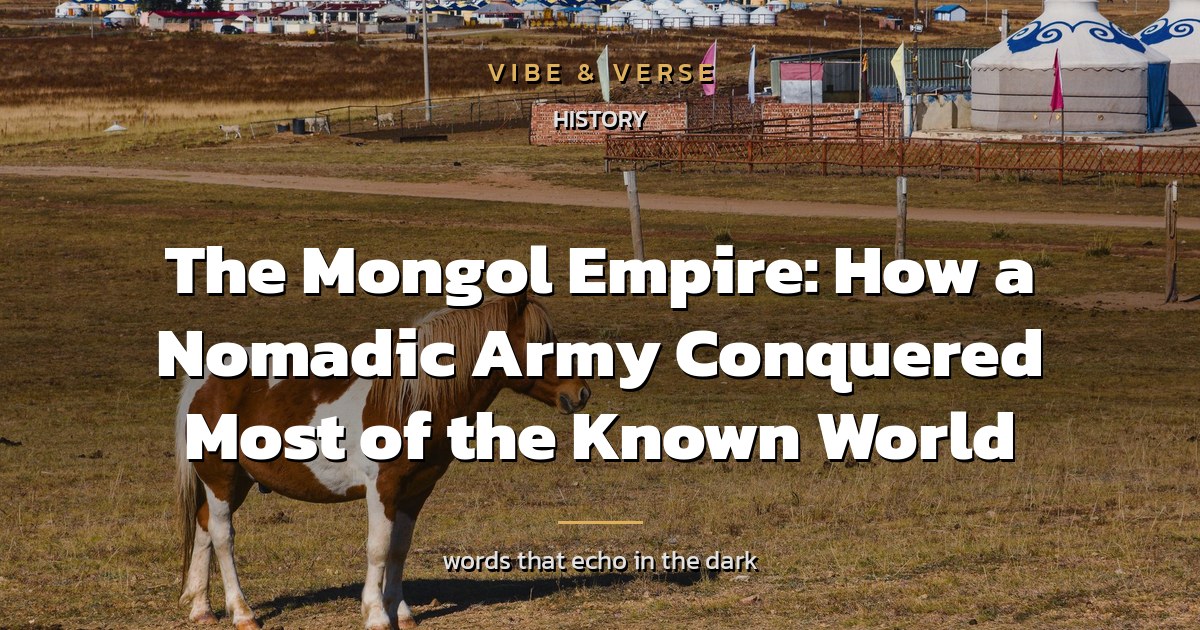
At its height in the late thirteenth century, the Mongol Empire stretched from the Sea of Japan to the Carpathian Mountains and from Siberia to the Persian Gulf — roughly 24 million square kilometres, the largest contiguous land empire that has ever existed.
It was assembled in under seventy years by a people numbering perhaps a million, from a region with no cities, no bureaucracy, and no written language of its own at the outset.
Understanding how requires setting aside the caricature of a horde. Hordes do not conquer China.
Before the empire: fragmentation
The Mongolian steppe in the twelfth century was a patchwork of rival tribes — Mongols, Tatars, Keraites, Naimans, Merkits — engaged in continuous raiding, kidnapping and blood feud. Chinese dynasties to the south had long managed this by playing the tribes against one another.
Temüjin, born around 1162, grew up inside that chaos. His father was poisoned by Tatars; his family was abandoned by their clan and survived in near-destitution; he was captured and enslaved as a youth before escaping.
His achievement, before any foreign conquest, was to end the fragmentation. Over roughly two decades he defeated or absorbed every rival confederation on the steppe, and in 1206 an assembly of Mongol leaders proclaimed him Genghis Khan.
The reforms that mattered
Unification alone would have produced another temporary steppe confederation. What made this one durable was a set of structural changes.
He broke up the tribes. Rather than leaving defeated peoples under their own leaders, Genghis distributed warriors across new units that mixed tribal origins deliberately. Loyalty was redirected from clan to army, and from army to khan.
He organised by decimal units. The army was structured in tens, hundreds, thousands and ten-thousands, each with a commander responsible for the unit below. This produced a clear chain of command and made large forces manoeuvrable in a way ad hoc tribal levies never were.
He promoted on merit. Commanders were selected for competence rather than birth. Subutai, arguably the most accomplished general of the era, was the son of a blacksmith.
He imposed a legal code. The Yassa established rules covering theft, feuding, the treatment of envoys, and religious practice. Blood feud, which had consumed the steppe for centuries, was suppressed.
He guaranteed religious tolerance. Buddhists, Muslims, Nestorian Christians, Daoists and shamanists were left to their practices, and clergy were exempted from taxation. This was not modern pluralism — it was an effective policy for governing conquered populations that had no interest in becoming Mongols.
Why the army was so effective
Mobility. Each warrior travelled with several remounts, switching horses to keep them fresh. A Mongol army could cover distances that European and Middle Eastern commanders did not believe possible, which repeatedly allowed them to appear where no army was expected.
Ranged combat. The composite bow of horn, wood and sinew was short enough to shoot from horseback and powerful enough to be lethal at long range. Mongol tactics revolved around shooting from a distance, avoiding close engagement, and letting the enemy exhaust itself.
Feigned retreat. The most famous Mongol tactic and one of the hardest to execute: a portion of the force would break and flee, drawing pursuers into disorder and away from support, then turn and destroy them with the rest of the army closing in. It required discipline that undisciplined opponents assumed was impossible, which is exactly why it kept working.

Intelligence. Before campaigns, Mongols gathered detailed information through merchants, envoys and captured scouts — roads, rivers, harvests, fortifications, and the political fractures they could exploit. The invasion of Europe in the 1240s followed a reconnaissance campaign years earlier.
Adopted technology. This is the decisive factor most often overlooked. Nomads cannot take walled cities. So the Mongols recruited Chinese and Persian engineers and acquired siege expertise wholesale — catapults, trebuchets, sappers, incendiaries. By the time they reached the Middle East, they were conducting sieges as capably as anyone.
Terror as policy. Cities that surrendered were generally spared and taxed. Cities that resisted and fell were destroyed, often with mass killing, and the news was allowed to travel ahead of the army. This was calculated: it made surrender the rational choice and reduced the number of sieges actually required. The brutality was real, and it was also a strategy.
The extent of it
Under Genghis, the Mongols destroyed the Khwarazmian Empire in Central Asia and campaigned deep into northern China.
After his death in 1227, expansion continued under his successors. Northern China fell; the campaign into Rus' in the 1230s subdued the principalities one by one; armies reached Hungary and Poland in 1241, defeating European forces at Legnica and Mohi. Baghdad, seat of the Abbasid Caliphate, fell in 1258.
The empire eventually fragmented into four khanates — the Yuan dynasty in China, the Ilkhanate in Persia, the Chagatai Khanate in Central Asia, and the Golden Horde in the Rus' lands and steppe — increasingly independent and sometimes at war with one another.
What it left behind
The destruction was enormous, and estimates of the death toll across the conquests run into the tens of millions. Irrigation systems in Persia and Central Asia were wrecked; some cities never recovered.
But the empire also produced consequences that outlasted it.
Trade across Eurasia became dramatically safer. With a single authority governing the length of the Silk Road, merchants could travel from the Black Sea to China with relative security. This period of increased exchange is often called the Pax Mongolica.
Ideas moved with the goods. Persian astronomers worked in China; Chinese medical texts reached Persia; gunpowder, printing and papermaking spread west. Diplomatic and commercial contacts between Europe and East Asia intensified sharply.
A postal relay system, the yam, maintained stations at regular intervals across the empire, allowing messages to travel at speeds unmatched in the region until the modern era.
Less happily, the same connectivity is widely implicated in the westward spread of the Black Death in the fourteenth century.
Summary
The Mongol Empire was not built by ferocity alone. Every steppe confederation had ferocity, and none of them conquered China and Persia.
What made the difference was organisational: units built on merit rather than clan, a legal code that ended internal feuding, systematic intelligence gathering, ruthless pragmatism about religion, and the willingness to hire the engineers of the people they had just defeated.
They were, in a specific and consequential sense, the best learners of their era — and they applied what they learned at a speed nobody around them could match.




Be the first to share a thought.