The Sun looks reassuringly constant. It rises, it sets, and the energy it delivers to Earth is stable enough that life has depended on it for billions of years. But the Sun is a churning ball of magnetised plasma, and its surface is anything but calm. Every so often it releases an eruption so large that it disturbs the space around our planet — a phenomenon we now call space weather, and one that modern technology is unusually vulnerable to.
What Causes a Solar Flare
The Sun rotates faster at its equator than at its poles. Since it is not solid, this differential rotation stretches and twists its internal magnetic field over time, winding it into increasingly strained configurations.
Where these twisted field lines break through the surface, they suppress the flow of heat from below, creating regions that are cooler and therefore darker than their surroundings. These are sunspots — visible markers of magnetic stress.
When the tangled field lines in these regions snap and reconnect into a simpler configuration, they release an enormous amount of stored magnetic energy at once. That is a solar flare: a sudden brightening across the electromagnetic spectrum, from radio waves to X-rays. The largest release energy equivalent to billions of hydrogen bombs, and the radiation reaches Earth in about eight minutes, travelling at light speed.
Coronal Mass Ejections Are the Bigger Threat
Flares often come with a companion event that matters more for us. A **coronal mass ejection**, or CME, is a vast bubble of magnetised plasma — billions of tonnes of it — physically thrown off the Sun.
CMEs travel far slower than light, typically arriving in one to three days. That delay is fortunate: it gives us warning time that a flare's radiation does not.
Whether a CME affects Earth depends on aim. Most miss entirely — space is large and Earth is a small target. And even a direct hit may do little if the magnetic orientation of the cloud aligns with Earth's own field rather than opposing it.
What Happens When One Hits
Earth's magnetic field deflects most incoming charged particles, which is why the atmosphere and the life beneath it have survived this long. But a strong CME compresses and distorts that field, and some particles funnel down along field lines toward the poles.
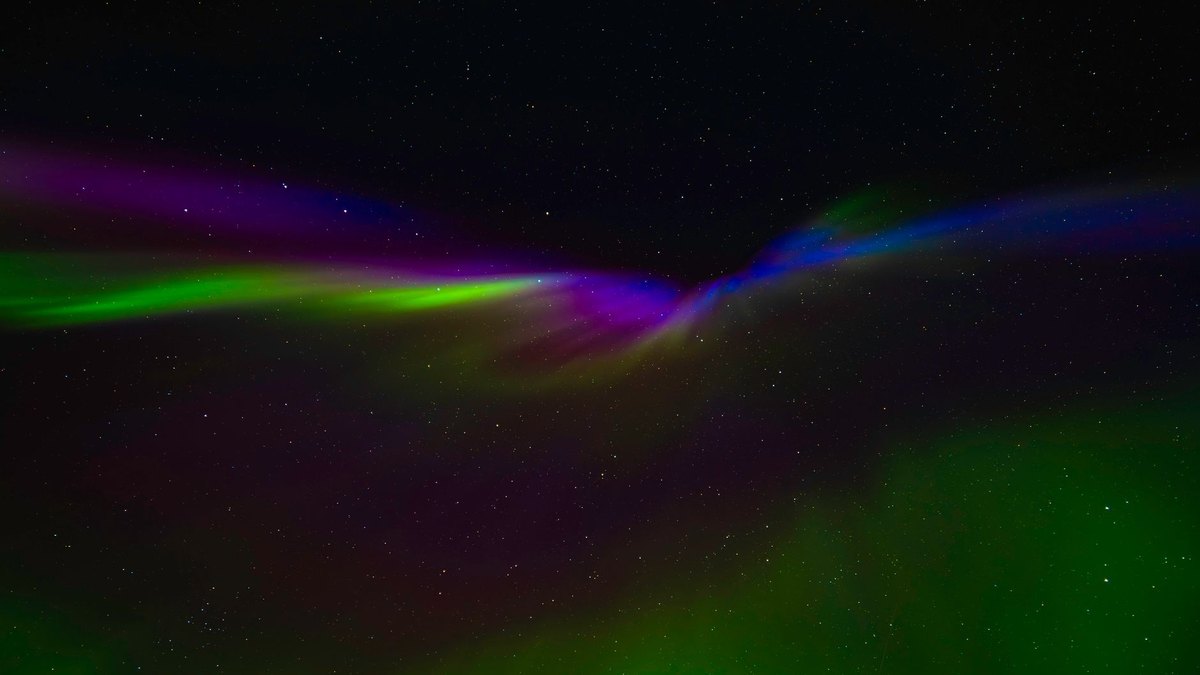
There they collide with atmospheric gases, exciting oxygen and nitrogen atoms that release the energy as light. That is the aurora — the visible, beautiful end of a violent process. Oxygen produces the familiar greens and, at higher altitudes, reds; nitrogen contributes blues and purples. During strong storms the auroral ovals expand far from the poles, which is why major events bring northern lights to latitudes that normally never see them.
The less beautiful consequence is electrical. A rapidly changing magnetic field induces currents in long conductors — a basic principle of physics. Earth's crust, undersea cables, pipelines, and above all power transmission lines all qualify. These **geomagnetically induced currents** flow where no engineer intended current to flow.
The Historical Benchmarks
**The Carrington Event, 1859.** The most intense geomagnetic storm on record. Auroras were reported as far south as the Caribbean, bright enough to read by. Telegraph systems — the only substantial electrical infrastructure at the time — failed spectacularly. Operators received shocks, paper caught fire, and some lines carried messages with their batteries disconnected, powered purely by induced current. In a world of telegraphs, this was an inconvenience. In a world of continental power grids, it would be something else.
**Quebec, March 1989.** A CME induced currents that overwhelmed protective relays in the Hydro-Québec grid. The entire province lost power in about ninety seconds. Six million people were without electricity for roughly nine hours, in winter. This remains the clearest demonstration that the threat is not theoretical.
**The 2012 near miss.** A CME comparable in strength to the Carrington Event crossed Earth's orbital path. Earth had been at that location roughly a week earlier. It was detected by a solar observatory spacecraft, and analysis suggested a direct hit would have caused severe global disruption.
**February 2022.** A relatively modest storm slightly expanded the upper atmosphere, increasing drag on newly launched satellites. Around forty were lost before reaching operational orbit — a reminder that even minor events have costs now.
Why We Are More Vulnerable Than We Used to Be
Every decade adds dependencies. High-voltage transformers are the critical weak point: they are enormous, expensive, largely custom-built, and can take a year or more to replace. Damaging many at once creates a repair problem no stockpile solves quickly.
Satellites face several hazards — radiation damaging electronics, charging that causes internal arcing, and atmospheric expansion increasing drag. GPS accuracy degrades during storms as the ionosphere becomes disturbed, which matters for aviation, shipping, agriculture, and financial systems that depend on precise timing signals.
High-frequency radio, used for polar aviation routes, can black out entirely. Airlines reroute flights during major events, at significant cost.
Can We Predict It?
Partially. Spacecraft monitor the Sun continuously, and sunspot regions capable of producing large flares can be identified in advance. The eleven-year solar cycle gives a broad sense of when activity will be elevated.
But precise prediction remains out of reach. We cannot reliably say when a specific region will erupt, and the critical property of an incoming CME — its magnetic orientation — is generally only measurable when it reaches monitoring spacecraft positioned about 1.5 million kilometres upstream. That gives roughly fifteen to sixty minutes of definitive warning.
Fifteen minutes is not much. But it is enough for grid operators to reduce loads, disconnect vulnerable transformers, and put systems into protective configurations — which is precisely why that early-warning infrastructure exists.
The Bottom Line
Space weather is a genuine hazard, neither imaginary nor apocalyptic. A Carrington-class event striking a modern grid would be seriously disruptive and expensive, and such events appear to occur on a timescale of roughly once or twice a century. The mitigations — better forecasting, hardened transformers, operational procedures — are well understood and only partly implemented. The next time an aurora appears far from the poles, it is worth remembering what it actually is: the visible edge of a collision between our planet's magnetic field and a piece of the Sun that came loose.



Be the first to share a thought.