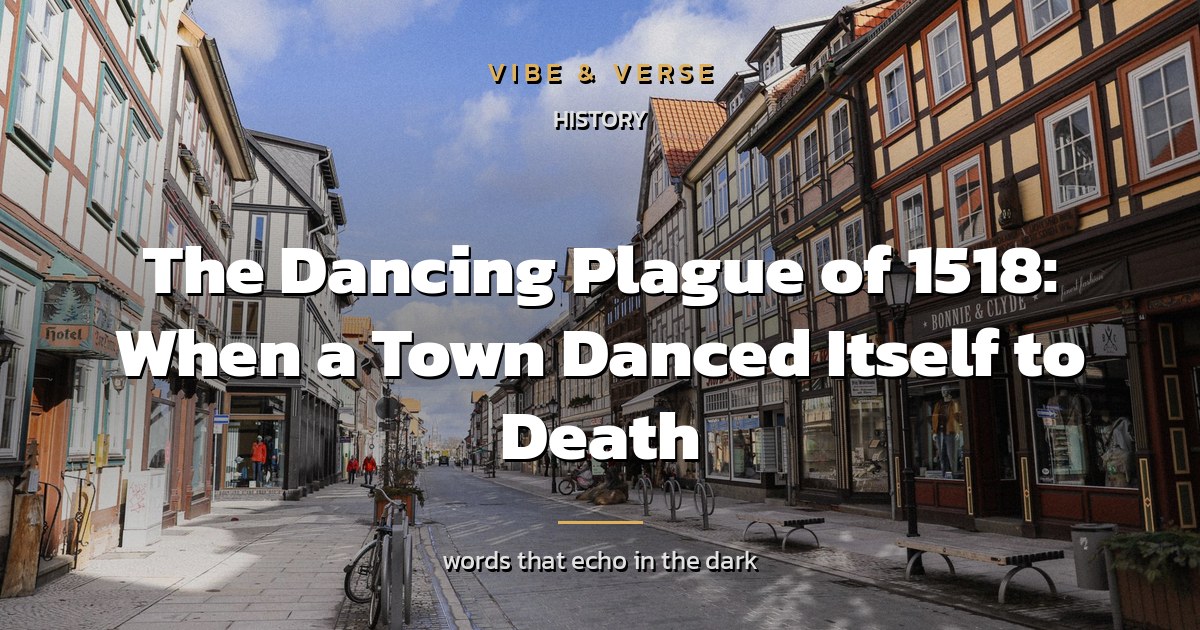
In July of 1518, in the city of Strasbourg — then part of the Holy Roman Empire — a woman known as Frau Troffea stepped into the street and began to dance. There was no music, no celebration, no apparent reason. She simply danced, and she did not stop. She danced through the day and into the night, and kept dancing for days. And then, impossibly, others began to join her.
Within a week, dozens were dancing. Within a month, the number had reportedly swelled to around 400 people, seized by the same compulsion. This was the Dancing Plague of 1518 — one of the strangest and best-documented events in all of history, recorded in physician notes, council records, and chronicles of the time. It really happened. The question is why.
Dancing to Exhaustion — and Death
This was not joyful dancing. Witnesses described people who appeared to be in torment, their faces blank or anguished, their bodies moving as if beyond their control. They danced for hours and then days, their feet bloodied, collapsing from exhaustion only to rise and continue. According to accounts of the time, the relentless physical strain led to strokes, heart attacks, and death for some of the afflicted.
Alarmed, the city authorities responded in a way that seems baffling today. Convinced the dancing could only be stopped by more dancing, they cleared guild halls, hired musicians, and even built a stage — hoping the afflicted would dance the malady out of their systems. Predictably, this only made things worse, spreading the frenzy further.
Searching for an Explanation
For five centuries, people have tried to explain the Dancing Plague, and no single answer is universally accepted.
One long-standing theory blames ergot, a toxic mold that grows on damp rye and can produce convulsions and hallucinations when eaten. But critics point out that ergot poisoning tends to cut off blood flow to the limbs, making sustained, coordinated dancing for days extremely unlikely.
The explanation many historians now favor is psychological: a case of mass hysteria, or mass psychogenic illness. Strasbourg in 1518 was a place of intense suffering — famine, disease, and crushing hardship had left the population desperate and fearful. Under extreme, shared stress, and steeped in local beliefs about a saint who could inflict a dancing curse, a single person's breakdown may have triggered a collective one, spreading through suggestion from body to body like a contagion of the mind.
Not the Only Time
As bizarre as it sounds, the 1518 outbreak was not entirely unique. Historical records describe similar episodes of compulsive group dancing in Europe across several centuries. The recurrence lends weight to the idea that these were social and psychological phenomena — eruptions of collective distress in populations pushed to their limits — rather than the result of a single toxin or disease.
The Takeaway
The Dancing Plague of 1518 endures because it sits at an unsettling intersection of the documented and the inexplicable. We know it happened; we're still not certain why. Its most likely explanation may be the most disquieting of all — that under enough fear and suffering, the human mind can seize a whole community at once, driving people to move until their bodies fail. It's a five-hundred-year-old reminder that some of history's strangest events unfold not in the body alone, but in the mysterious, shared spaces of the mind.




Be the first to share a thought.