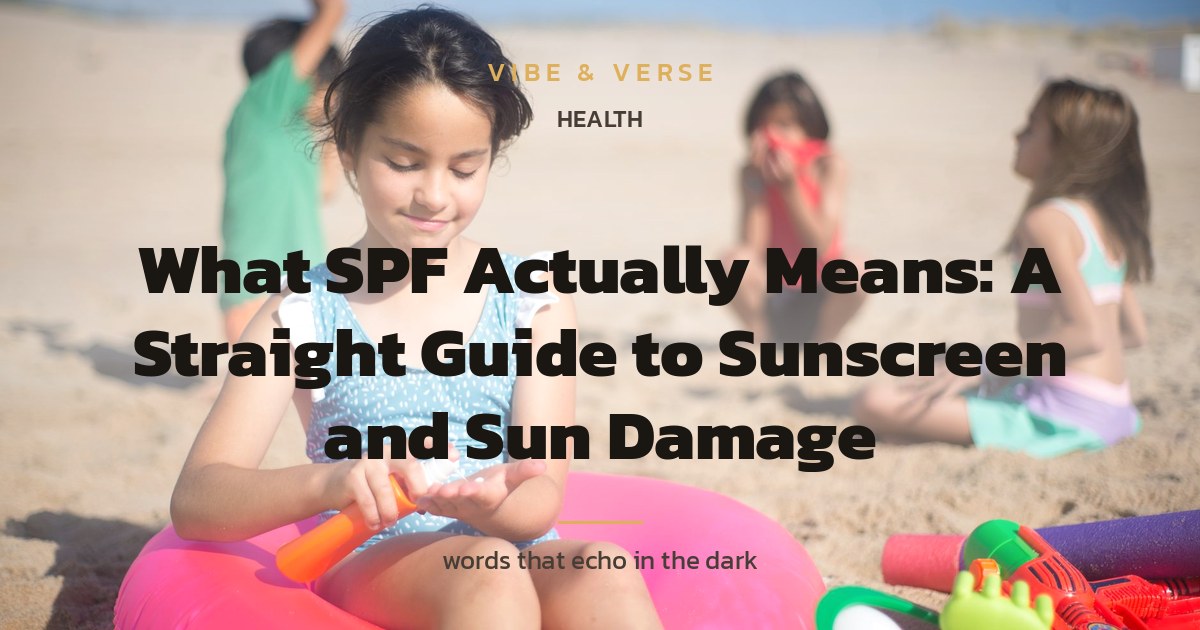
Sunscreen labelling is a small masterpiece of accidental confusion. The headline number is calculated from a laboratory test that bears almost no resemblance to how anyone uses the product, it describes only one of the two kinds of ultraviolet radiation that damage skin, and it scales in a way that makes higher numbers look far more impressive than they are.
None of this means sunscreen does not work. It works well. But using it effectively requires knowing what the label is actually claiming.
Two kinds of ultraviolet light
Sunlight that reaches the ground contains two relevant bands of ultraviolet radiation.
**UVB** has a shorter wavelength and carries more energy per photon. It is absorbed in the outer layer of skin, and it is what burns you. It is also the main driver of direct DNA damage in skin cells and the primary cause of most skin cancers. UVB intensity varies enormously by time of day, season and latitude — it is far stronger at midday in summer than in the early morning in winter.
**UVA** has a longer wavelength and penetrates deeper, reaching the dermis where collagen and elastin live. It does not burn efficiently, which is precisely what makes it deceptive: you can accumulate substantial UVA exposure without any warning signal. UVA is the main driver of photoageing — wrinkles, loss of firmness, and uneven pigmentation — and it also contributes to skin cancer risk. UVA levels stay relatively constant through the day and across seasons, and UVA passes through window glass, which UVB largely does not.
The classic demonstration is a photograph of a long-haul lorry driver whose left side, the window side, aged dramatically faster than his right over decades of driving.
What the SPF number measures
SPF stands for Sun Protection Factor, and it measures protection against UVB only. It is defined as the ratio of how much UV energy is needed to produce a visible burn on protected skin versus unprotected skin.
The intuitive reading — "SPF 30 means I can stay out 30 times longer" — is roughly the intent, but it collapses in practice because it assumes a fixed application thickness and no sweating, swimming, rubbing or degradation over time.
The more useful way to read the number is as a percentage of UVB blocked:
- SPF 15 blocks about 93%
- SPF 30 blocks about 97%
- SPF 50 blocks about 98%
- SPF 100 blocks about 99%
Notice what happens. Doubling from 15 to 30 removes over half the remaining exposure. Doubling again from 30 to 50 removes far less. Going to 100 changes almost nothing. The curve flattens hard, which is why several regulators cap the number that can be printed on a label — beyond a point, the higher figure mostly encourages people to feel invulnerable and stay out longer.
Why "broad spectrum" is the more important phrase
Because SPF measures UVB alone, a product could in principle score highly while offering weak UVA protection. Different regions handle this differently. The term **broad spectrum** indicates that a product has passed a test showing meaningful protection across both bands. In Europe and much of Asia you may also see a **PA** rating with plus signs, or a **UVA** logo inside a circle, both indicating UVA performance specifically.
If you care about ageing as well as burning — and most people do — the broad spectrum indicator matters more than pushing the SPF number higher.
The application problem
Here is the gap that undermines everything else. SPF is measured in laboratories using two milligrams of product per square centimetre of skin. Studies of real-world use consistently find people apply somewhere between a quarter and a half of that.

Protection does not decline in proportion to the shortfall. It declines faster. Applying half the tested amount of an SPF 50 product does not leave you with SPF 25 — depending on the formulation, it can leave considerably less.
For an adult in swimwear, the tested amount is roughly 30 to 35 millilitres — about a shot glass — for the whole body. For the face and neck alone, the commonly cited guides are two finger-lengths of product squeezed along the index and middle fingers, or roughly a third of a teaspoon.
Most people are startled by how much that is. Applying a generous amount of SPF 30 will protect you better than a thin smear of SPF 50.
Reapplication is not optional
Sunscreen degrades. Chemical filters are gradually consumed as they absorb UV energy. Mineral filters get rubbed, sweated and washed off. Towel-drying removes a substantial share of whatever is left.
The standard advice — reapply every two hours, and immediately after swimming or heavy sweating — exists because of this decay. "Water resistant" on a label means the product retained its rating after either 40 or 80 minutes of water immersion in testing. It does not mean waterproof, and no sunscreen is.
Chemical versus mineral filters
**Chemical (organic) filters** such as avobenzone, octocrylene and the newer generation of filters absorb UV radiation and dissipate it as a small amount of heat. They tend to be lighter on the skin, spread easily and leave no visible residue, which makes daily use more likely. Some can sting sensitive eyes, and a few degrade in sunlight unless stabilised by other ingredients in the formula.
**Mineral (inorganic) filters** — zinc oxide and titanium dioxide — sit on the surface and mainly scatter and reflect radiation. They start working immediately, are typically better tolerated by sensitive and reactive skin, and zinc oxide in particular offers strong UVA coverage. The traditional drawback is a white cast, which modern micronised formulations have reduced but not always eliminated, especially on deeper skin tones.
Neither category is inherently superior. The best sunscreen is a broad spectrum one you will actually apply in sufficient quantity, every day, without resenting it.
Things that quietly increase exposure
- **Cloud cover.** A meaningful fraction of UV passes through light cloud. Overcast days still cause burns.
- **Reflection.** Water, wet sand, concrete and especially snow bounce UV back at you, effectively raising your dose. Snow can nearly double it.
- **Altitude.** UV intensity rises noticeably with elevation as the atmosphere thins.
- **Shade.** Helpful, but partial. Scattered UV arrives from the whole sky, not only directly from the sun.
- **Medications.** Some antibiotics, retinoids, diuretics and acne treatments increase photosensitivity substantially.
Sunscreen is one layer, not the whole strategy
Dermatologists generally treat sunscreen as the last line rather than the first. Shade, timing and clothing do more, more reliably. A tightly woven long-sleeved shirt provides consistent protection that does not wash off, degrade or need reapplying. A wide-brimmed hat shields the areas most commonly missed — ears, the back of the neck, the temples. Sunglasses protect the eyelids, where skin cancers are both common and easy to overlook.
Avoiding peak intensity hours, roughly the middle of the day, removes the largest share of exposure with no product required at all.
Summary
SPF measures UVB protection only, and its returns diminish sharply above 30. Look for broad spectrum coverage, because UVA does the ageing damage without the warning of a burn. Apply far more than feels natural — most people use a fraction of the tested amount — and reapply every couple of hours in strong sun. Then treat sunscreen as one layer alongside shade, timing and clothing, rather than a licence to stay out longer.
*General information only, not medical advice. Speak to a doctor or dermatologist about your own skin and any changing moles.*




Be the first to share a thought.