Every person who has ever looked up at the Moon — every ancestor, every civilisation, every astronomer before 1959 — has seen exactly the same face. The same dark patches, the same craters, in the same arrangement. The far side remained completely unknown until a Soviet spacecraft photographed it, and no human eye saw it directly until Apollo 8 rounded the Moon in 1968. This is not a coincidence, and it isn't because the Moon doesn't rotate. The explanation is a slow gravitational process called tidal locking.
The Common Misconception
It's tempting to assume the Moon keeps one face toward us because it doesn't spin. In fact the opposite is true: the Moon rotates on its axis at precisely the rate needed to complete one turn per orbit. It takes about 27.3 days to go around Earth and about 27.3 days to rotate once. Those two periods are locked together, and that synchronisation is what keeps the same hemisphere pointed at us.
If the Moon stopped rotating entirely, we would see all of it over the course of a month.
How Tidal Locking Happens
Gravity doesn't pull on an object uniformly. The side of the Moon facing Earth feels a slightly stronger pull than the far side, which stretches the Moon very slightly along the Earth–Moon line. The same effect works in reverse and is what produces ocean tides on Earth.
Early in its history, the Moon rotated much faster. That rotation kept dragging its tidal bulge slightly ahead of the Earth–Moon line. Earth's gravity pulled back on that displaced bulge, creating a persistent torque that acted like a brake. Over hundreds of millions of years, the braking slowed the Moon's spin until the bulge stayed aligned — at which point the torque vanished and the rotation stabilised.
This is not unusual. Most large moons in the solar system are tidally locked to their planets, including all four of Jupiter's Galilean moons. Pluto and its moon Charon are locked to each other, so each permanently shows the same face to the other.
We Actually See More Than Half
The neat picture of exactly fifty percent visibility isn't quite right. Over time we can see about fifty-nine percent of the lunar surface, thanks to an effect called libration.
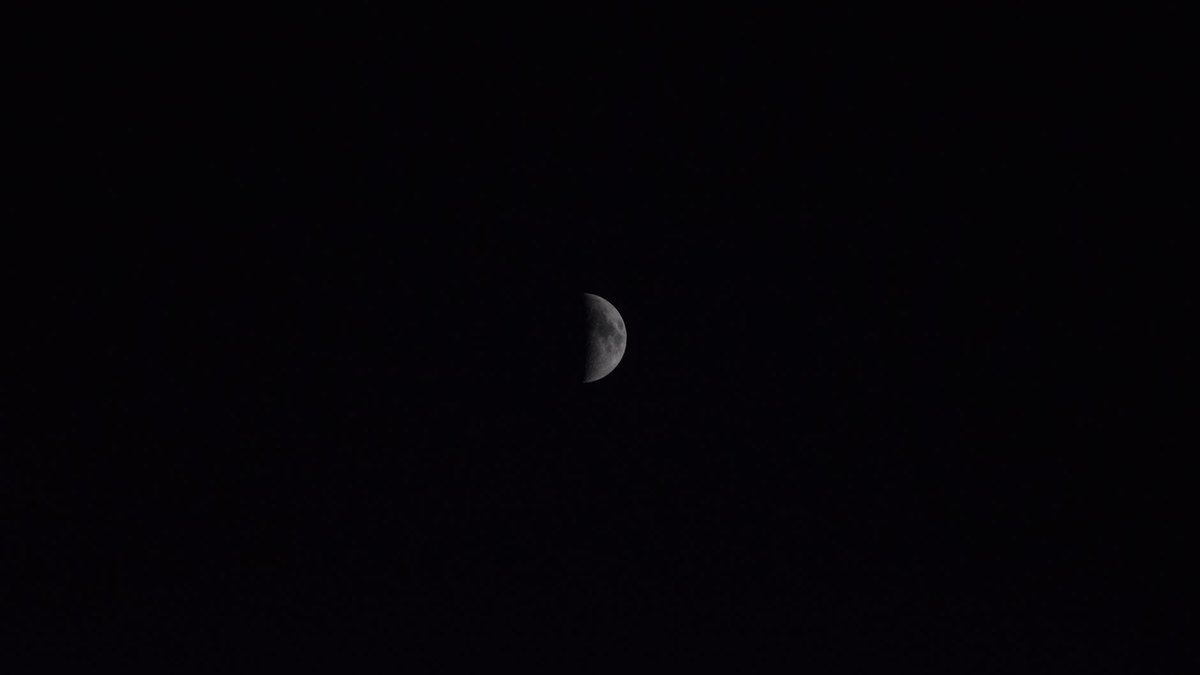
The Moon's orbit is slightly elliptical, so its orbital speed varies while its rotation stays constant. That mismatch lets us peek a little around the eastern and western edges. Its axis is also tilted relative to its orbit, allowing glimpses over the north and south poles. And because Earth is large, an observer sees a slightly different angle from moonrise to moonset. Together these effects rock the Moon gently in our view, revealing an extra sliver.
The Far Side Is Not the Dark Side
The far side receives just as much sunlight as the near side — it simply does so on a different schedule. During a new moon, when the near side is dark to us, the far side is in full daylight. Calling it the dark side is a poetic habit rather than a description.
What is genuinely strange about the far side is how different it looks. The near side is marked by large dark plains called maria, ancient basins flooded by basaltic lava. The far side has very few. Its crust is measurably thicker, which likely made it harder for magma to reach the surface. Why the crust differs in thickness is still debated, with one leading idea being that a second smaller moon once collided with it gently and plastered itself onto the surface.
Earth Is Slowing Down Too
The process runs in both directions. The Moon raises tidal bulges in Earth's oceans, and friction from those tides is gradually slowing Earth's rotation by roughly 1.7 milliseconds per century. Angular momentum has to go somewhere, so the Moon is drifting away from us at about 3.8 centimetres a year — a figure measured precisely by bouncing lasers off reflectors left by Apollo astronauts.
Given enough time, Earth would eventually become tidally locked to the Moon as well, with a day and a month of equal length. The timescale involved is far longer than the remaining lifetime of the Sun, so it will never actually happen.
The Bottom Line
The Moon shows us one face not because it's still, but because gravity spent billions of years tuning its spin until it matched its orbit exactly. It's a quiet demonstration of how patient physics can be — a process too slow to notice in a human lifetime, yet completely decisive over the age of the solar system. The next time you look up, it's worth remembering you're seeing the outcome of a very long negotiation between two worlds.

Be the first to share a thought.