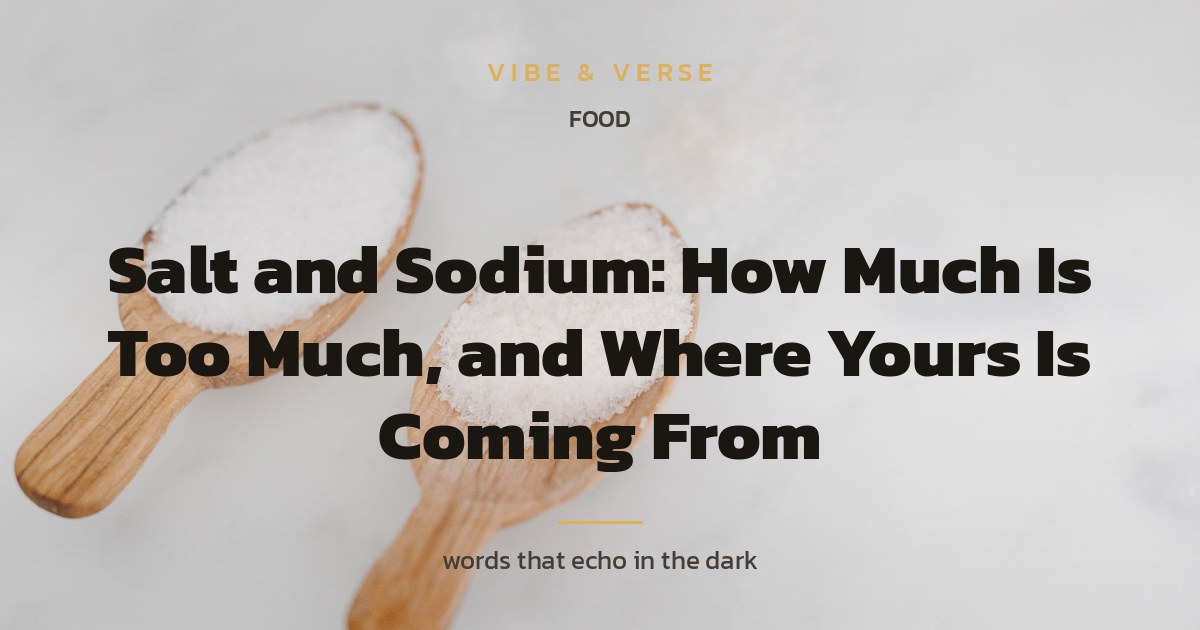
Salt is one of the oldest and most useful ingredients humans have. It preserves food, suppresses bitterness, makes sweetness read as more intense, and carries aroma. Cooking without any of it produces food that tastes flat in a way that no other seasoning quite fixes.
It is also the single dietary factor most consistently linked to raised blood pressure across populations. Both things are true, which is why the sensible conversation is about quantity and sourcing rather than elimination.
Salt is not the same as sodium
Table salt is sodium chloride. By weight it is roughly 40% sodium and 60% chloride. The sodium is the part that matters for health, and it is the figure health guidelines use.
The conversion is straightforward and worth memorising:
- 1 gram of salt contains about 0.4 grams (400mg) of sodium
- 1 gram of sodium comes from about 2.5 grams of salt
- 1 teaspoon of salt is roughly 6 grams of salt, or about 2,300mg of sodium
That last figure is a useful anchor, because one teaspoon of salt is approximately the entire daily upper limit recommended by most public health bodies.
Labels complicate this by using both units depending on the country. Some list sodium in milligrams, others list salt in grams. Multiplying sodium in grams by 2.5 gives salt; dividing salt by 2.5 gives sodium.
The recommended numbers
Most authorities converge on a daily sodium limit of around **2,000 to 2,300mg** for adults, equivalent to 5 to 6 grams of salt. Several bodies suggest an ideal target closer to 1,500mg for people with raised blood pressure or elevated cardiovascular risk.
Actual consumption in most countries sits between 3,000 and 5,000mg per day. In parts of East and Southeast Asia, where soy sauce, fish sauce, fermented pastes and preserved vegetables are staples, intake is frequently at the upper end of that range or beyond.
The body's genuine physiological requirement is far lower — a few hundred milligrams daily. Sodium deficiency from ordinary eating is essentially unheard of outside of extreme endurance exertion or specific medical conditions.
Why the number matters
Sodium governs how much fluid your body holds. When sodium concentration in the blood rises, the body retains water to dilute it. More fluid in a fixed volume of vessels means higher pressure against the vessel walls.
Sustained high blood pressure is the leading modifiable risk factor for stroke, and a major contributor to heart attack, heart failure, kidney disease and vascular dementia. It causes no symptoms for years while doing steady damage, which is why it is described as silent.

Sensitivity varies considerably between individuals. Roughly a quarter to half of people are notably salt-sensitive, with blood pressure that responds strongly to intake. Salt sensitivity increases with age, and tends to be higher among people with existing hypertension, diabetes or kidney impairment. Since there is no routine test to determine which group you fall into, the general recommendation applies broadly.
High sodium intake is also associated with increased risk of stomach cancer and with greater urinary calcium loss, which has implications for bone density.
Where it actually comes from
This is the part that surprises people. In countries where the food supply is heavily processed, studies consistently find that roughly **70 to 80%** of dietary sodium comes from packaged and restaurant food — not from cooking or the table shaker, which together account for maybe 10 to 15%.
The largest contributors are rarely the foods that taste saltiest:
- **Bread and baked goods** — modest sodium per slice, but eaten in quantity, making it a top source in many countries
- **Processed and cured meat** — bacon, ham, sausages, deli slices
- **Cheese**, particularly hard and processed varieties
- **Soups, stocks and bouillon cubes** — a single cube can carry a substantial share of a day's limit
- **Sauces and condiments** — soy sauce, fish sauce, oyster sauce, ketchup, stock pastes
- **Savoury snacks** — crisps, crackers, salted nuts
- **Ready meals and instant noodles** — a single instant noodle packet frequently exceeds 1,500mg
- **Pickles, preserved vegetables and fermented pastes**
Breakfast cereal, sweet biscuits and tinned vegetables also contribute quietly, because sodium is used as a preservative and flavour enhancer well beyond obviously savoury products.
Sea salt, rock salt and pink salt
These contain trace minerals that ordinary refined salt lacks, and they differ in crystal size and texture. In terms of sodium, they are essentially interchangeable — all are around 98% sodium chloride, and the trace mineral quantities are far too small to be nutritionally meaningful at the amounts anyone consumes.
Coarse flaky salt does have one genuine advantage: because the crystals are larger, a given volume contains less sodium than the same volume of fine salt, and flakes sitting on the surface of food hit the tongue directly, delivering more perceived saltiness per milligram. Finishing a dish with a pinch of flaky salt rather than salting heavily during cooking is a real technique, not just presentation.
Potassium is the other half of the equation
Sodium and potassium work in opposition in regulating fluid balance and blood pressure. Most people eat too much of the first and too little of the second, and the ratio between them may matter as much as the absolute sodium figure.
Potassium-rich foods include beans and lentils, leafy greens, potatoes and sweet potatoes, bananas, tomatoes, avocado, yoghurt and fish. Increasing these has a measurable effect on blood pressure independent of cutting sodium.
Potassium-based salt substitutes replace part of the sodium chloride with potassium chloride, and large trials have found meaningful reductions in stroke and cardiovascular events from switching. One important caveat: people with kidney disease, or taking certain blood pressure medications that raise potassium, should not use these without medical advice, because impaired kidneys cannot clear excess potassium safely.
Practical ways to cut back
- **Read labels and compare within a category.** Sodium content between two similar breads or two brands of stock can differ by a factor of three.
- **Cook more from raw ingredients.** This single change does most of the work, because it removes the processed-food share.
- **Use acid and aromatics.** Lemon, lime, vinegar, garlic, ginger, chilli, black pepper and fresh herbs make food taste more vivid without sodium. Acid in particular makes food read as better seasoned than it is.
- **Salt at the end, on the surface.** More perceived saltiness for less total sodium.
- **Dilute high-sodium condiments.** Cutting soy or fish sauce with water, citrus or a little sugar preserves the flavour profile at lower concentration.
- **Rinse tinned beans and vegetables.** Draining and rinsing removes a meaningful share of the added sodium.
- **Reduce gradually.** Taste receptors adapt over roughly a month or two. Food that seems bland at first stops seeming bland, and previously normal foods start tasting aggressively salty.
Summary
Salt is 40% sodium, and one teaspoon is about a full day's recommended limit. Most people eat roughly double, and the majority arrives through bread, processed meat, sauces, snacks and ready meals rather than the shaker. Cooking from raw ingredients, comparing labels within categories, seasoning at the end, and eating more potassium-rich foods will move the number further than giving up the salt shaker ever will. Taste adapts within weeks.


Be the first to share a thought.