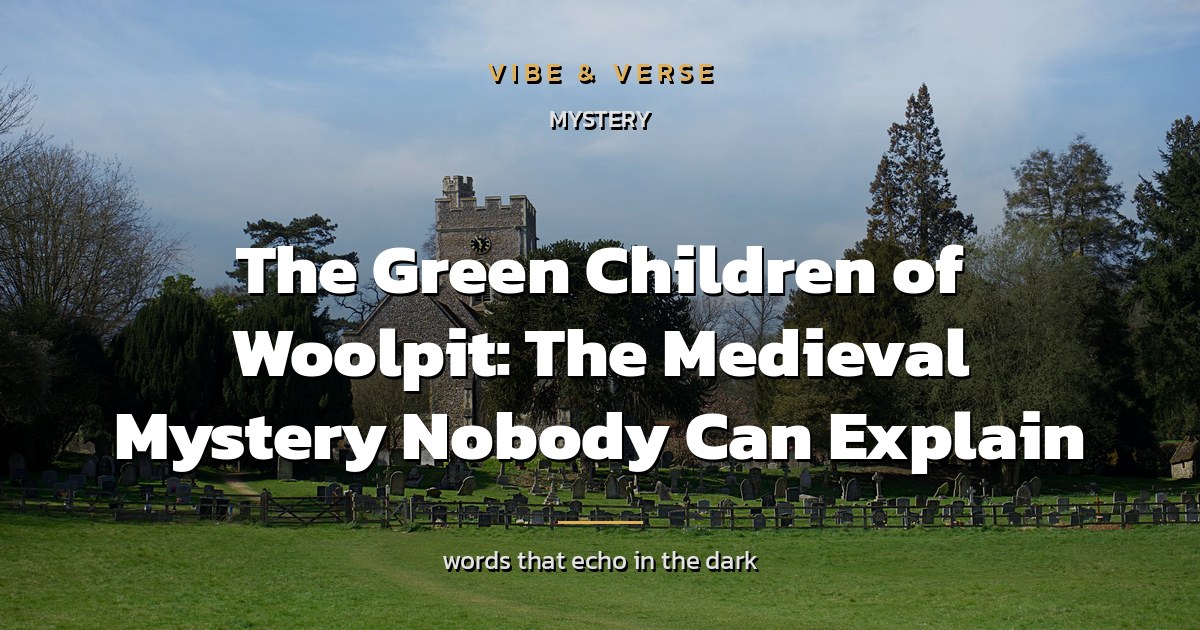
Some mysteries survive because there is too little evidence. This one survives because there is just enough. Two respected medieval chroniclers, writing independently, recorded the same strange event in the same Suffolk village — and neither of them presented it as a legend. They presented it as news.
What the chronicles say
The village is Woolpit, in Suffolk, England. The name comes from the Old English for "wolf pits," trenches dug to trap wolves, which is relevant later. The event is usually dated to the reign of King Stephen, roughly the 1140s, though one source places it slightly later.
According to the accounts, harvesters working the fields found two children — a boy and a girl — near one of the wolf pits. The children were distressed and disoriented. Three details made them extraordinary:
- Their skin was green.
- They wore clothing of an unfamiliar material and cut.
- They spoke to each other in a language nobody present could identify.
They were taken to the home of a local landowner, Sir Richard de Calne. There they refused all food offered to them for several days, apparently on the edge of starvation, until someone brought in freshly cut beans still on the stalk. The children tore the stalks open looking for food inside, found the pods empty, and wept. When shown how to open the pods themselves, they ate eagerly — and for months afterwards they ate nothing else.
The boy sickened and died not long after being baptised. The girl survived, gradually lost her green colour, learned English, was baptised, and eventually — according to one chronicler — married a man from King's Lynn and lived an ordinary life.
Once she could speak English, she was asked where they had come from. Her answer is the strangest part of the whole account.
The girl's story
She said they came from a place called Saint Martin's Land, where everyone was green like them, and where the sun never rose properly — the light was permanently like the light just before sunrise or after sunset. There was another luminous country visible across a wide river, she said.
She and her brother had been herding their father's cattle when they followed the animals into a cavern. They heard the sound of bells, walked toward it, and emerged into blinding sunlight in the fields at Woolpit, where they were overwhelmed by the light and the heat until the harvesters found them.
Why this account is unusual
Most medieval marvels reach us through a single source, or through folklore written down centuries later. This one has two near-contemporary chroniclers.
Ralph of Coggeshall was abbot of a Cistercian monastery in Essex, roughly 25 miles from Woolpit. He wrote in his Chronicon Anglicanum that he had the story from Richard de Calne himself — the man who took the children in. Ralph was, by the standards of his time, a fairly careful writer who distinguished between things he had witnessed, things he had from named informants, and things he had merely heard.
William of Newburgh was an Augustinian canon in Yorkshire, several hundred miles away, writing his Historia rerum Anglicarum around 1189. William is remembered by historians as one of the more sceptical writers of his era — he openly mocked Geoffrey of Monmouth's Arthurian material as invention. Yet he included the Woolpit account, noting that he had long resisted believing it, and accepted it only because the testimony was so widespread and so consistent.
Two independent chains of transmission, one of them traced to a named eyewitness household, is a stronger evidentiary base than almost any comparable medieval marvel. That does not make the story true. It makes it interesting.
The explanations
Chlorosis, or "green sickness"

The most commonly cited natural explanation. Chlorosis was a recognised form of severe iron-deficiency anaemia, historically noted in malnourished adolescents, which can give the skin a pale greenish or sallow tint. It fits several details neatly: the children were starving, they recovered their normal colour once they ate a varied diet, and the boy — who ate least and died soonest — never recovered. A diet consisting almost entirely of beans would worsen the deficiency, since compounds in legumes inhibit iron absorption.
The Flemish immigrant hypothesis
Suffolk had a substantial Flemish population in the 12th century. Flemish settlers were violently persecuted during the civil war of Stephen's reign, and many were killed at the Battle of Fornham in 1173. Under this reading, the children were Flemish orphans who fled a massacre, spoke Flemish (unintelligible to Suffolk villagers but recognisable as human speech), and became lost in an area riddled with mine workings and underground passages. "Saint Martin's Land" may point to Fornham St Martin, a village a few miles away. The bells could be church bells; the strange twilight, the dimness of the tunnels they hid in.
The problem is that Flemish was not an exotic language in 12th-century East Anglia. Someone should have recognised it. Defenders of the theory note that traumatised children speaking a regional dialect, to a farm crowd in shock, may not have been understood as clearly as we assume.
The folklore reading
Some scholars argue the story is not a report at all but a folk narrative that acquired documentary trappings. It contains motifs common in medieval European fairy tradition: an underground otherworld, a green-skinned people, entry through a cave, and food that binds a person to one world or the other. In this reading, the "reality" of the account is a matter of how medieval writers handled the boundary between marvel and fact — a boundary they drew very differently from us.
The exotic explanations
Later writers have proposed that the children were extraterrestrial, or arrived through some kind of dimensional slip. These readings have no evidentiary support whatsoever, and they explain the account only by adding assumptions far stranger than the account itself. They persist because they are entertaining, not because they are plausible.
What we can actually say
We can say with confidence that two independent 12th-century writers believed something unusual had happened at Woolpit, and that one of them traced his information to the household that took the children in. We cannot verify the green skin, the language, or the girl's account of her homeland — all of which reach us second- or third-hand, through writers with their own conventions about what marvels meant.
The most defensible position is that something happened: two lost, starving, foreign children were found near Woolpit, and the details accumulated a fairy-tale shape as the story travelled. That is not a dramatic conclusion, but it is the one the evidence supports.
Why it endures
The Woolpit story sits in an unusual place. It is too well documented to dismiss as pure invention, and too strange to accept at face value. Every explanation offered — anaemia, immigration, folklore — accounts for most of the details and leaves a residue that it cannot quite cover.
The village of Woolpit still has the children on its sign. Nine centuries later, that residue is still there.




Be the first to share a thought.