When we picture the solar system, we imagine the Sun and its planets. But the Sun's true domain reaches almost unimaginably farther — into a vast, spherical shell of icy bodies that surrounds everything, so distant it's nearly halfway to the next star. This is the Oort Cloud, the mysterious outermost frontier of our solar system and the cradle of the great comets that occasionally visit our skies.
A Shell Around the Whole Solar System
Unlike the planets and the Kuiper Belt, which lie in a relatively flat disk, the Oort Cloud is thought to be a giant sphere completely enclosing the solar system. Imagine a hollow ball of countless icy objects, with the Sun and all its planets sitting as a tiny speck at the very center. This shell is believed to hold a huge number of frozen bodies, drifting slowly in the deep cold and dark.
Almost Unimaginably Far Away
The scale of the Oort Cloud is staggering. It's so distant that sunlight, which reaches Earth in about eight minutes, would take a very long time to travel there. Its outer edge may lie a significant fraction of the way to the nearest neighboring star. Out at that distance, the Sun would appear as little more than a particularly bright star in a black sky, and the objects there feel only the faintest tug of its gravity.
This remoteness is exactly why the Oort Cloud has never been directly observed. Its objects are small, dark, and unimaginably far, making them essentially invisible with current technology. Its existence is inferred from the comets it sends inward.
The Home of Long-Period Comets
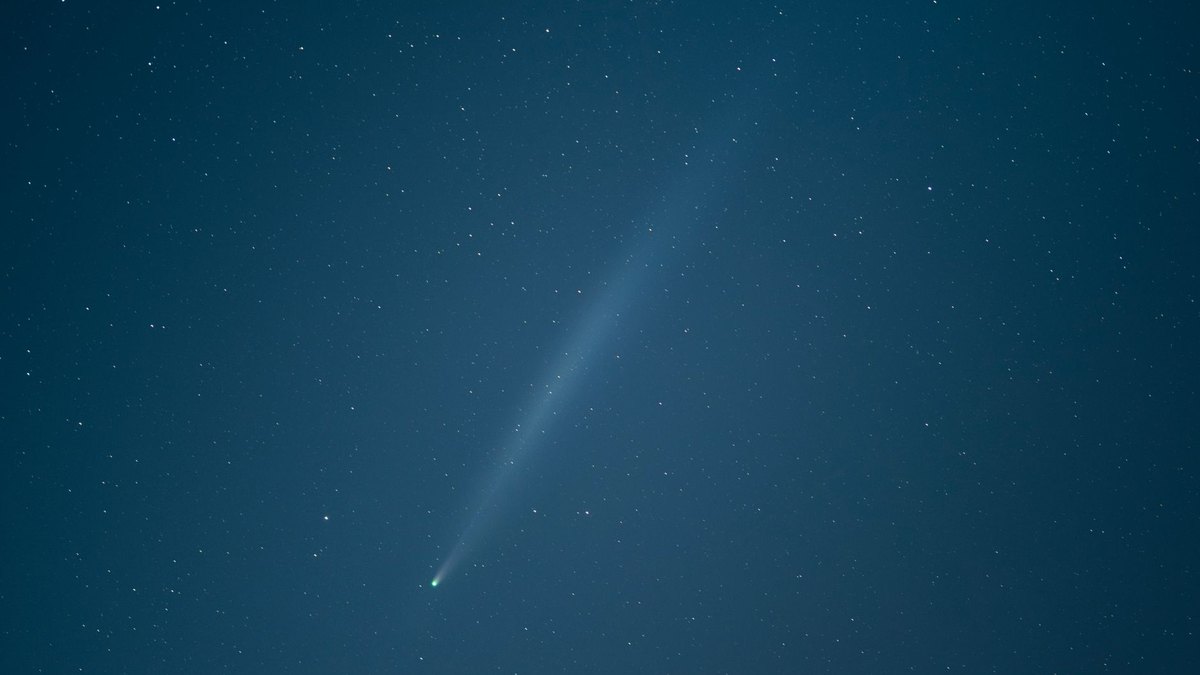
The Oort Cloud is believed to be the source of long-period comets — the ones that swing through the inner solar system on enormous orbits, sometimes taking thousands or even millions of years to complete a single loop. Every so often, a passing star or the gravity of the galaxy itself nudges one of these distant icy bodies, sending it falling inward toward the Sun. As it nears the Sun's heat, it grows a glowing coma and a long tail, becoming the spectacular comets we occasionally see.
Frozen Relics of Creation
Like other icy bodies in the outer solar system, the objects of the Oort Cloud are thought to be leftovers from the birth of the planets billions of years ago. Scientists believe many were formed closer to the Sun and then flung far outward by the gravity of the giant planets, settling into the distant shell we picture today. That makes the Oort Cloud a deep-freeze archive of primordial material, largely untouched since the solar system's earliest days.
The Edge of the Sun's Realm
In a real sense, the Oort Cloud marks the true boundary of the solar system — the farthest reach where the Sun's gravity still holds sway over objects. Beyond it lies genuine interstellar space. It represents the frontier between our home system and the wider galaxy, a faint and frozen borderland we've only begun to understand.
The Takeaway
The Oort Cloud stretches our sense of just how big the solar system really is. Far past the planets, past even the icy Kuiper Belt, a vast sphere of frozen worlds quietly encloses everything we call home. We've never seen it directly, yet we know it by the comets it sends us — brief, brilliant visitors from the dark edge of the Sun's domain. It's a humbling reminder that our familiar solar system is wrapped in a frozen frontier so distant, we're only just beginning to imagine it.


Be the first to share a thought.