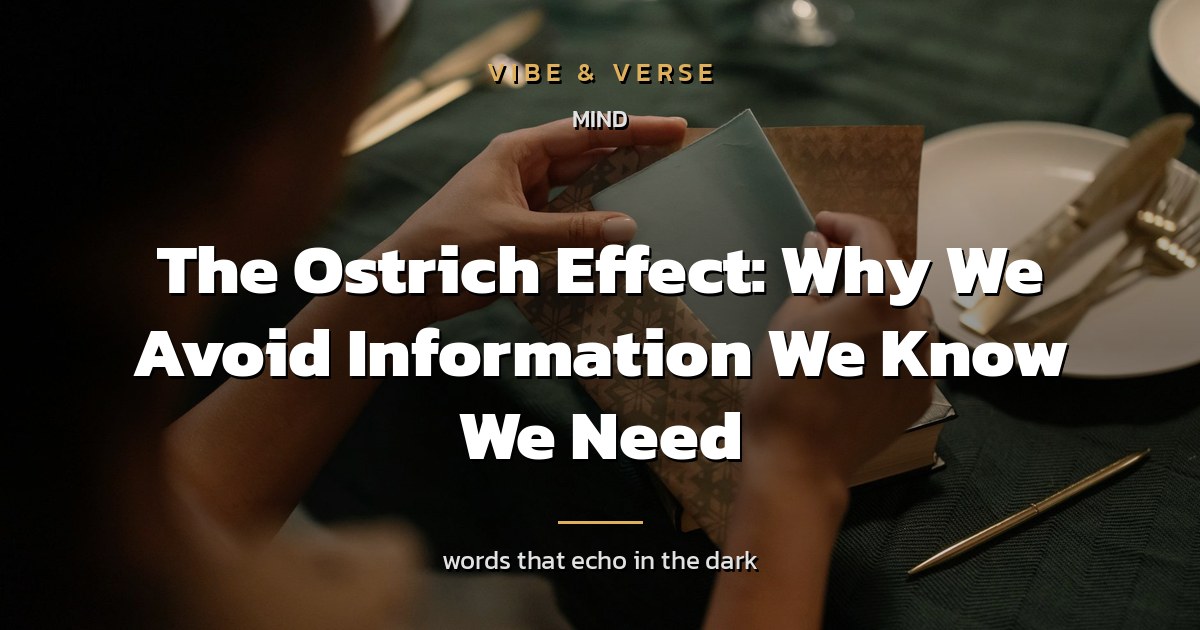
There is a specific kind of not-knowing that people choose on purpose.
The envelope from the bank stays on the counter for a week. The blood test result sits unopened in the patient portal. The investment app goes unchecked for months, and then suddenly gets checked five times a day when the news turns good. The lump gets noticed, and then unnoticed.
Behavioural economists call this the ostrich effect, after the myth that ostriches bury their heads in sand. The birds do not actually do this. People reliably do.
The finding that named it
Researchers studying investor behaviour noticed something odd in account login data. When markets were rising, people logged in frequently. When markets fell, logins dropped sharply — by roughly half in some analyses of Scandinavian and American investor data.
This is backwards from a purely rational standpoint. Falling markets are precisely when new information has the most decision value: whether to rebalance, whether to buy, whether your risk tolerance was overestimated. Rising markets require no action at all.
But logins do not track information value. They track expected emotional payoff. People were not checking their portfolios to make decisions. They were checking them to feel good, and stopping when it stopped feeling good.
Information has two prices
Standard economic models treat information as costly to acquire but valuable to have. The ostrich effect exposes a second cost that the models miss: information can hurt, and people are willing to pay to avoid the hurt.
Once you accept that knowing has an emotional price as well as a practical value, the behaviour becomes coherent. Avoidance is not irrational within the moment. It is a purchase — comfort now, in exchange for accuracy and options later.
The problem is that the price is paid on a delay, and almost always turns out to be higher than it looked.
Where it does the most damage
Health. The most costly domain by far. Symptoms noticed and not investigated. Screening appointments postponed indefinitely. Results left unread in an app. Nearly every condition where early detection matters is a condition where avoidance converts a treatable problem into a serious one.
Debt. Unopened statements are a hallmark of escalating financial trouble. The behaviour is self-reinforcing: not knowing the balance means not knowing how bad it is, which makes opening the next letter more frightening, which makes the balance grow further through interest and late fees.
Work. The email whose subject line signals a problem gets left for tomorrow. The performance review feedback goes unread. The project metric that would show the plan is failing goes unexamined until it is unrecoverable.
Relationships. The conversation everyone knows is coming keeps not happening. Each postponement raises the cost of the eventual conversation and lowers the chance of a good outcome.
Business and institutions. Organisations do this at scale — the audit nobody commissions, the customer complaint data nobody aggregates, the safety report filed and unread. Institutional ostriching has caused more disasters than institutional malice.
Why it feels reasonable at the time
Avoidance almost never presents itself as avoidance. It arrives dressed as something sensible.

- "I'll deal with it when I have the headspace"
- "There's nothing I can do about it right now anyway"
- "It's probably nothing"
- "I don't want to overreact"
- "I'll wait until after the holidays"
Each is locally plausible. That is what makes the pattern so durable — every individual postponement can be defended, while the sum of them cannot.
There is also a real and underrated component: avoidance sometimes works. Many worries do resolve on their own. Every time that happens, the strategy is reinforced. What people fail to notice is that the cases where avoidance fails are precisely the high-stakes ones.
The self-reinforcing loop
The cruel structure of the ostrich effect is that avoidance increases the fear that drives it.
Unknown problems grow in imagination. An unopened bill becomes, in the mind, larger than any bill has ever been. An unexamined symptom becomes every disease it could theoretically be. The anxiety of not knowing is often worse and longer-lasting than the anxiety of knowing, because uncertainty gives fear unlimited room to expand.
Most people who finally open the envelope report the same thing: it was bad, but it was smaller than the version they had been carrying around.
How to counter it
Notice the tell. The physical flinch when your eye passes over a particular item is the signal. Anything you have "been meaning to deal with" for more than two weeks is probably being avoided rather than deferred.
Separate looking from fixing. Much avoidance is really avoidance of the response, not the information. Give yourself explicit permission to look and do nothing — open the statement, read the number, close it. Removing the obligation to act removes most of the resistance to knowing.
Make it automatic. Scheduled quarterly portfolio reviews, annual health checks, a fixed monthly hour for bills. Automation beats motivation because it removes the moment of choice, which is where avoidance operates.
Shorten the gap. The longer information sits unopened, the more frightening it becomes. A same-day rule for opening post and results is easier than any later intervention.
Bring another person. Avoidance thrives in private. Booking the appointment with a friend, or reviewing the accounts with a partner, converts an avoidable private task into a social commitment.
Pre-commit while calm. Decide in advance what you will do if the number is bad. A plan made before the fear arrives is far better than one made during it — and having a plan removes the reason to fear looking.
Ask what the delay costs. Not "what might I find out" but "what does another three months of not knowing cost me?" That reframe reliably moves people, because the second question has a concrete answer and the first does not.
The uncomfortable summary
The ostrich effect is not stupidity, and telling someone to stop avoiding rarely works — they already know. It is a trade: certainty deferred, comfort delivered now, interest charged later.
The single most useful thing to internalise is that the information does not change while you are not looking at it. The tumour, the balance, the losing quarter, the failing relationship — all of them continue on their trajectory regardless of your attention. The only variable your avoidance controls is how many options you have left when you finally look.
Almost always, that number is highest today.

Be the first to share a thought.