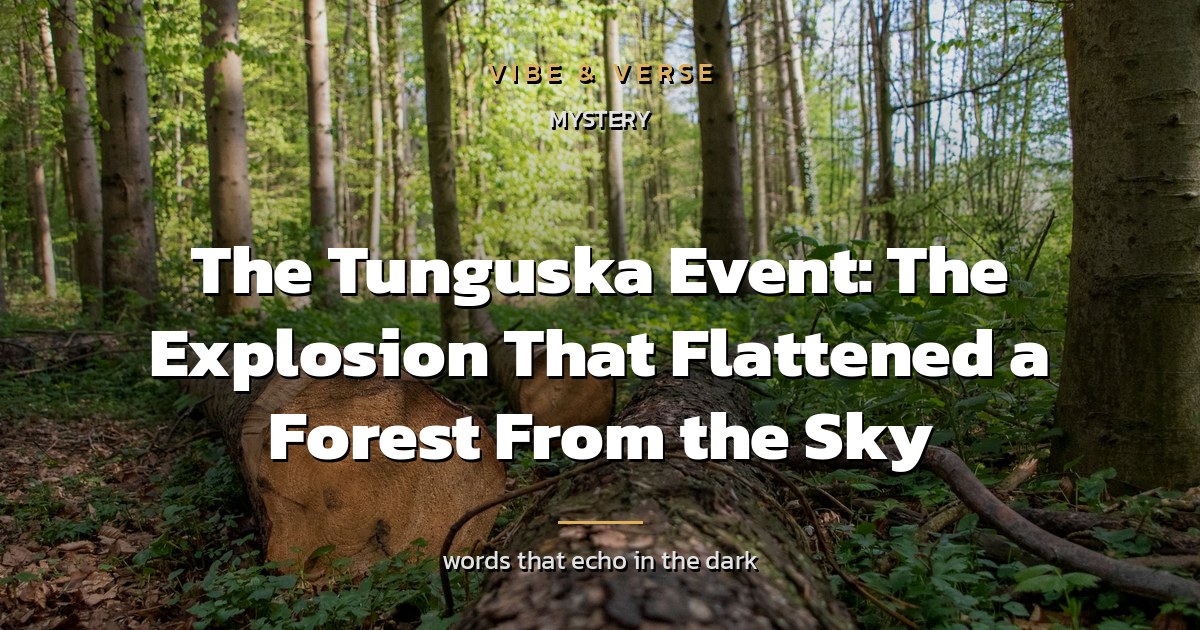
On the morning of June 30, 1908, in a remote stretch of Siberian forest near the Tunguska River, the sky tore open. Witnesses far away described a column of blue light nearly as bright as the sun moving across the heavens, followed by a flash and a shockwave that knocked people off their feet and shattered windows hundreds of kilometers away. In an instant, roughly 80 million trees across some 2,000 square kilometers were flattened. It remains the largest impact event in recorded history — and for a long time, a genuine mystery.
A Blast Without a Crater
The most puzzling thing about Tunguska was what investigators didn't find. When the first scientific expedition finally reached the remote site nearly two decades later, they expected a giant crater. Instead they found something eerier: a vast forest of trees knocked flat and pointing outward from a central zone, like spokes radiating from a hub. Strangely, at the very center, some trees were left standing upright but stripped bare of branches and bark.
There was no crater. No obvious chunk of meteorite. Just devastation on an enormous scale, with nothing at its heart to explain it.
What Really Happened
Today, scientists are confident about the broad picture. The Tunguska event was almost certainly caused by a relatively small asteroid or comet fragment — perhaps a few tens of meters across — that entered the atmosphere at enormous speed. Rather than striking the ground, it exploded in the air several kilometers up, in what's called an airburst.
The intense heat and pressure of hitting the atmosphere at such velocity caused the object to violently disintegrate before impact, releasing energy estimated at hundreds of times the atomic bomb dropped on Hiroshima. That airburst explains everything the expedition found: the radiating pattern of flattened trees, the trees left standing directly beneath the blast where the shockwave came straight down, and the absence of a crater, because the object never actually reached the ground intact.

The Lingering Questions
Most of the mystery is solved, but a few threads remain. Because no large fragment was ever definitively recovered, scientists still debate whether the object was a rocky asteroid or an icy comet — a comet would have vaporized more completely, helping explain the lack of debris. The exact size, speed, and composition are still estimated rather than known.
That uncertainty, plus the sheer strangeness of the scene, fueled decades of wilder speculation — from antimatter to alien spacecraft. But none of these are needed. The natural explanation of an airburst accounts for the evidence remarkably well.
A Warning From the Sky
Tunguska's real significance is sobering. An object small enough that we might struggle to spot it in advance leveled an area large enough to destroy a major city, and it happened in living memory. Had it arrived hours later, with the Earth rotated slightly, the same blast could have struck a populated region. It stands as the clearest modern reminder that the sky is not entirely empty, and that even modest visitors from space can arrive with catastrophic force.
The Takeaway
The Tunguska event began as a true mystery — a colossal explosion with no crater and no clear cause — and science has since pieced together most of the answer: a cosmic intruder that blew apart in the air above Siberia. What lingers isn't really doubt about what happened, but respect for what it means. Once, within the last century or so, the sky delivered a blow of staggering power to an empty forest. Tunguska is the reminder that next time, the target might not be empty.




Be the first to share a thought.