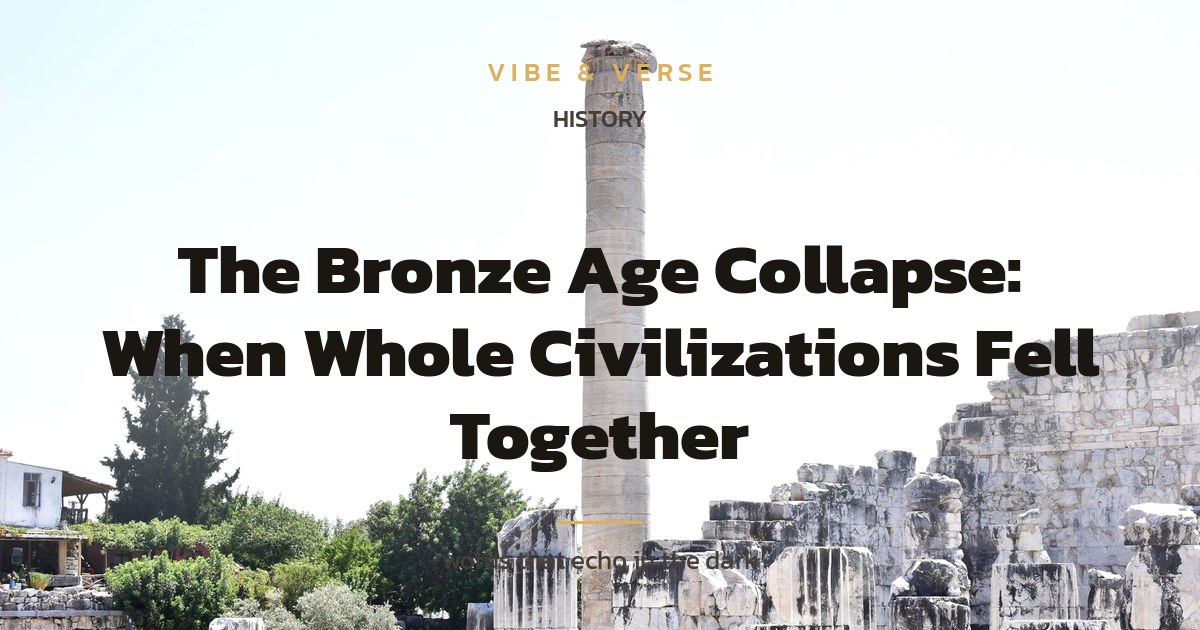
Around three thousand years ago, the eastern Mediterranean was home to a dazzling web of connected civilizations — the Egyptians, the Hittites, the Mycenaean Greeks, and others — trading, writing, and building great cities. Then, within the span of a few decades around 1200 BC, nearly all of them collapsed. Cities were burned and abandoned, entire kingdoms disappeared, writing systems were lost, and a dark age descended. The Bronze Age Collapse is one of history's greatest and most debated catastrophes — and we still aren't certain what caused it.
A Connected World
Before the collapse, the late Bronze Age was surprisingly interconnected. Kingdoms exchanged goods, letters, and gifts across long distances. Bronze itself — the era's essential metal, used for tools and weapons — required tin and copper that often had to be traded over great distances. This made the whole system prosperous but also fragile: each civilization depended on the others, and on the trade routes that linked them.
The World Falls Apart
Then, over a relatively short period, it all came undone. One great city after another was destroyed or abandoned. Powerful kingdoms that had stood for centuries simply ceased to exist. International trade broke down. In some regions, the very knowledge of writing was lost for generations, plunging societies into a dark age from which they took a long time to recover. It was not the fall of a single empire, but the near-simultaneous collapse of an entire interconnected world.
The Suspects
No one is certain why it happened, and historians still argue about it. Several causes have been proposed, and the truth likely involves many at once:
- **The mysterious "Sea Peoples."** Ancient records describe waves of raiders arriving by sea, attacking and destroying coastal cities. Who exactly they were remains debated.
- **Climate change and drought.** Evidence suggests a period of prolonged drought struck the region, causing crop failures, famine, and desperate movements of people.
- **Earthquakes.** A series of major earthquakes may have struck the region in this era, damaging cities already under strain.
- **System collapse.** Because the civilizations were so interdependent, trouble in one place could ripple outward. Once trade and stability broke in enough places, the whole tightly linked system may have unraveled like falling dominoes.
A Warning About Fragility
The most compelling explanation isn't any single disaster, but the way they combined. A prosperous, deeply connected world may have been more vulnerable than it appeared. When drought, invasion, and instability struck at once, the very connections that made these societies rich became the channels through which collapse spread. Complexity, it turns out, can be a strength and a weakness at the same time.
The Takeaway
The Bronze Age Collapse is a haunting reminder that civilizations are not permanent, and that even prosperous, sophisticated societies can fall — sometimes quickly, sometimes together. Three thousand years later, its causes are still argued over, but its lesson lingers: an interconnected world is powerful but delicate, and when too many shocks arrive at once, even the mightiest kingdoms can vanish into the dark, leaving ruins and unanswered questions for those who come after.




Be the first to share a thought.