It is one of the few stories from the First World War that people tell to children. On Christmas Eve 1914, along parts of the Western Front, soldiers stopped shooting. They climbed out of their trenches, walked into the ground between the lines, and met the men who had been trying to kill them that morning. They exchanged food, tobacco, and buttons. In some places they buried their dead together. In a few, they played football.
The story has been sentimentalised so heavily that it is easy to assume it has been exaggerated into myth. It has not. It is documented in letters, diaries, regimental records, and contemporary newspapers. What is usually lost is the context — why it happened, how limited it was, and why it never happened again.
The War Was Supposed to Be Over
The men in those trenches had been told the war would be finished by Christmas. Instead, the German advance had been halted at the Marne in September, both sides had raced to outflank each other to the North Sea, and by November the front had frozen into a line of trenches running roughly 700 kilometres from the Channel to Switzerland.
Casualties had already been staggering. The British Expeditionary Force that landed in August had been largely destroyed as a fighting formation. And the war had not yet acquired the industrialised bitterness of later years — no poison gas, no Somme, no Verdun. The men facing each other in December 1914 had been fighting for four months, not four years.
Conditions were miserable in a way that affected both sides identically. That winter was wet. Trenches flooded. Men stood in freezing water, developed trench foot, and could not get warm or dry. The lines in places were less than a hundred metres apart — close enough to hear each other talking and singing.
The Build-Up
The truce was not entirely spontaneous. Informal local arrangements had already been emerging along quiet sections of the front — brief unofficial pauses to recover wounded men or bury the dead lying between the lines. Soldiers on both sides had learned that shooting at fixed times and holding fire at others made life survivable.
There had also been a public appeal. Pope Benedict XV had called in early December for an official Christmas truce, asking "that the guns may fall silent at least upon the night the angels sang." The warring governments declined.
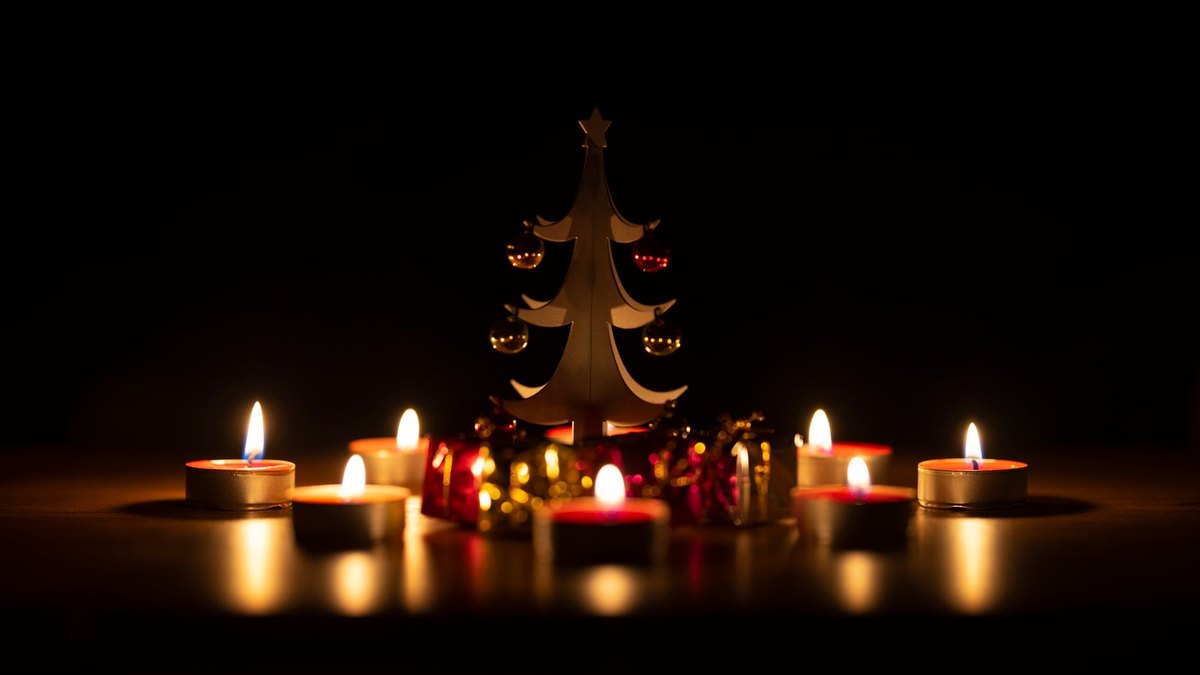
Then, in the week before Christmas, German units received large quantities of gifts from home — including small Christmas trees, *Tannenbäume*, with candles. This detail turned out to matter enormously.
Christmas Eve
British accounts are consistent on how it began. As darkness fell on 24 December, men in the British lines saw lights appearing along the German parapet — candles on small trees, set openly on the sandbags. Then they heard singing.
"Stille Nacht" carried across no man's land. British troops responded with carols of their own. Shouted exchanges followed — greetings, jokes, and eventually invitations.
Somewhere along the line, someone climbed out unarmed. Then others did. In the end, an estimated 100,000 men participated in some form of truce along the British and German sectors.
What Actually Happened Between the Lines
The accounts that survive are strikingly mundane, which is part of what makes them credible.
Men swapped rations — British bully beef and plum pudding for German sausage and sauerkraut. They traded cigarettes, cigars, chocolate, and alcohol. Tunic buttons and cap badges were popular souvenirs. Addresses were exchanged, and a few men wrote to each other after the war.
The most practically important activity was burying the dead. Bodies had lain in no man's land for weeks because retrieving them meant being shot. Joint burial services were held, with chaplains from both sides reading over the graves of men from both armies.
There were haircuts. There was at least one case of a German who had worked as a barber in London before the war cutting British hair between the lines.
The Football
The football matches are the most famous element and the most disputed. The evidence suggests they happened, in a limited and informal way, in perhaps a handful of places.
Several letters describe kickabouts — not organised matches with teams and referees, but scratch games with improvised balls, sometimes bundles of rags or tins. One frequently cited German account records a game ending 3–2 to the Germans. Regimental diaries from at least a few units mention football.
What almost certainly did not happen is the tidy version in popular retellings: a proper match with defined sides across a broad front. The reality was messier and smaller, and no less remarkable for it.
How Widespread It Was
This is where the popular story overreaches. The truce was **not universal.** It occurred mainly along British and German lines in Flanders, and in some German-French and German-Belgian sectors.
In many places nothing happened at all. In some, attempts to fraternise were met with fire. French and Belgian troops were fighting on occupied home soil and were generally far less inclined to fraternise than the British, who had no invaded homes behind them.
Some sectors saw fighting continue at full intensity throughout Christmas Day. Men died on 25 December 1914.
The End of It
Truces lasted anywhere from a few hours to, in isolated cases, into the New Year. Where officers on both sides tolerated it, it lasted longer. Where senior command found out early, it was shut down quickly.
The reaction from high command was uniformly hostile. Fraternisation with the enemy undermined the willingness to fight, which was precisely the point commanders understood. Orders were issued forbidding any repetition. Artillery bombardments were scheduled for subsequent Christmases specifically to prevent quiet from developing. Units were rotated to break up local familiarity between opposing trenches.
It worked. There were small localised truces later in the war, but nothing remotely on the scale of 1914. By Christmas 1915, gas had been used at Ypres, and the mood had changed permanently.
Why It Still Matters
The Christmas Truce is often told as a story about the triumph of human decency, and there is truth in that. But its more uncomfortable lesson is about how war is sustained.
The men in those trenches discovered, when given a few hours without orders, that they had no personal quarrel with the men opposite. The armies' response was not to deny it but to make sure the discovery could not be repeated — by scheduling bombardments, rotating units, and issuing explicit prohibitions.
The Bottom Line
For a few hours on a cold night in 1914, in an unplanned and unofficial way, tens of thousands of men decided to stop. Then they went back to their trenches, and in most places resumed fighting within a day or two. Many of them were dead within a year. The truce changed nothing about the course of the war, which is precisely why it has endured as a story — not as a turning point, but as evidence of what the men fighting it were capable of when nobody was giving them orders.




Be the first to share a thought.