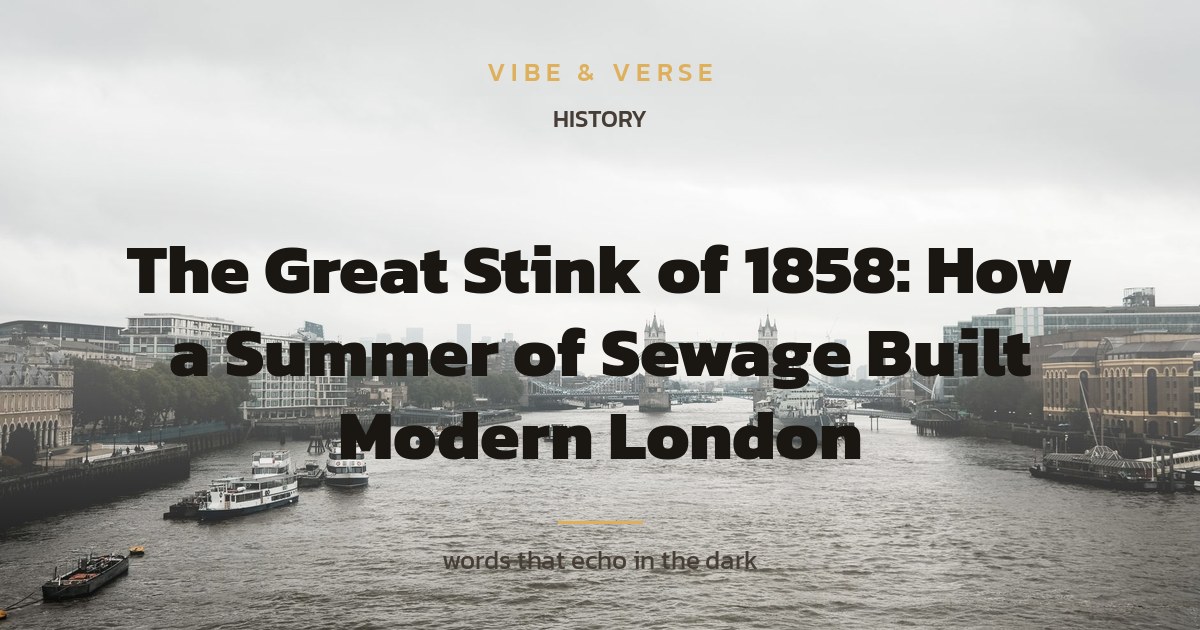
In the summer of 1858, London stopped functioning properly because of a smell. The Thames, into which the waste of more than two million people flowed untreated, baked under an unusually hot sun until the stench became genuinely unbearable. Curtains at the Houses of Parliament were soaked in chloride of lime in a futile attempt to filter the air. Members debated relocating the entire government to Oxford. The episode became known as the Great Stink — and it produced, within a decade, one of the most consequential engineering projects in urban history.
A City Outgrowing Its Plumbing
London's population had roughly doubled in the first half of the nineteenth century. Its sanitation had not kept pace at all. Waste went into cesspits beneath houses, emptied irregularly by "night soil men," or ran through medieval drains built for rainwater into the river.
The situation worsened, paradoxically, because of an improvement. The flush toilet spread rapidly through the 1840s and 1850s. Each one drained into a cesspit never designed for that volume, and overflow was routed into the storm drains — which emptied into the Thames. A public health measure in 1848 that required cesspits to be connected to sewers accelerated the problem enormously. London had effectively plumbed itself directly into its own drinking water source.
The Miasma Mistake
Victorian medicine held that disease spread through "miasma" — foul air rising from decaying matter. Cholera epidemics in 1832, 1848, and 1854 killed tens of thousands, and the smell was blamed.
In 1854, the physician John Snow traced a Soho outbreak to a single contaminated water pump on Broad Street and argued that cholera spread through water, not air. His analysis was careful and, as we now know, correct. It was largely dismissed at the time. The miasma theory was too entrenched, and Snow could not explain a mechanism — the germ theory of disease was still years away.
The irony is considerable: the eventual solution came about because officials wanted to stop the smell, not because they accepted Snow's argument. They got the right answer for the wrong reason.
The Summer Everything Changed
June 1858 brought sustained heat. The Thames, at that point effectively an open sewer, was reduced by low water levels and warmed until the decomposing matter along its banks became overwhelming.
The critical detail is where Parliament sat: directly on the riverbank. Legislators who had ignored years of reports about conditions in poor districts now could not open a window. Disraeli reportedly fled a committee room clutching a handkerchief to his face. The press covered it relentlessly.

A bill authorising and funding a comprehensive sewer system passed in about eighteen days.
Bazalgette's System
The work fell to Joseph Bazalgette, chief engineer of the Metropolitan Board of Works. His design was elegant in principle: instead of letting sewers discharge into the Thames throughout the city, he built massive intercepting sewers running roughly parallel to the river, which caught the flow and carried it east, downstream of the population, to be discharged on the outgoing tide.
The numbers were extraordinary for the period. Around 132 kilometres of main intercepting sewers, connected to more than 1,700 kilometres of street sewers. Some 318 million bricks. Pumping stations built like cathedrals. New embankments along the Thames that narrowed and deepened the river, improving its flow while providing space for the sewers, a new road, and later the Underground.
Bazalgette made one decision that has been quietly repaid ever since. Calculating the maximum volume the system would need, he then doubled the diameter of the pipes, reasoning that unforeseen growth was certain. Much of that Victorian network is still in service today, carrying a city far larger than he was designing for.
The Result
Deaths from cholera in London fell dramatically after the system came into operation. The last major outbreak, in 1866, was concentrated in an East End district not yet connected to the new sewers — a grim natural experiment that made the case beyond argument.
Bazalgette was knighted. His system became a template studied by engineers worldwide, and the embankments he built remain among the most recognisable features of central London.
What It Illustrates
The Great Stink is often told as a comic anecdote about Victorian politicians and bad smells. The more useful reading is about how institutions respond to problems. The evidence for reform had existed for years, documented in official reports, affecting mainly people without political power. Nothing moved. What moved things was the problem arriving, physically and unavoidably, in the room where decisions were made.
The Bottom Line
Modern London's sanitation exists because in one hot summer the consequences of inaction reached the people responsible for acting. The system built in response outlasted the empire that funded it and still works. It's a monument to good engineering — and a reminder that a crisis is often the only argument that gets heard.





Be the first to share a thought.